一、本文介绍
本文给大家带来的改进机制是 轻量级 的变换器 模型 : Illumination Adaptive Transformer (IAT) ,用于 图像增强 和曝光校正。其基本原理是通过 分解图像信号处理器(ISP)管道到局部和全局图像组件 ,从而 恢复在低光或过/欠曝光条件下的正常光照sRGB图像 。具体来说,IAT使用注意力查询来表示和调整ISP相关参数,例如颜色校正、伽马校正。模型具有约90k参数和约0.004s的处理速度,能够在低光增强和曝光校正的基准数据集上持续实现优于最新技术(State-of-The-Art, SOTA)的性能,我们将其用于YOLOv11上来改进我们模型的暗光检测能力,同时本文的内容不影响其它的模块改进。
欢迎大家订阅我的专栏一起学习YOLO!

二、基本原理
 论文地址:
官方论文地址点击此处即可跳转
论文地址:
官方论文地址点击此处即可跳转
代码地址: 官方代码地址点击此处即可跳转
2.1 IAT原理
本文提出了一个轻量级的 变换器 模型: Illumination Adaptive Transformer (IAT) ,用于图像增强和曝光校正。其基本原理是通过 分解图像信号处理器(ISP)管道到局部和全局图像组件 ,从而 恢复在低光或过/欠曝光条件下的正常光照sRGB图像 。具体来说,IAT使用注意力查询来表示和调整ISP相关参数,例如颜色校正、伽马校正。模型具有约90k参数和约0.004s的处理速度,能够在低光增强和曝光校正的基准数据集上持续实现优于最新技术(State-of-The-Art, SOTA)的性能。
Illumination Adaptive Transformer (IAT)的 基本原理 如下:
1. 轻量级变换器架构: IAT设计为一个轻量级的模型,具有大约90,000个参数,专注于图像增强和曝光校正任务。这使得它在处理速度和资源消耗上非常高效,适用于实时或资源受限的应用场景。
2. 图像信号处理器(ISP)管道分解: IAT的核心原理是模拟并改进传统的ISP管道。通过分解ISP处理过程中的局部和全局图像成分,IAT能够针对特定的光照条件调整图像的视觉表现。
3. 适应性光照调整: IAT能够根据输入图像的光照条件动态调整处理策略,有效地处理低光、过曝光和欠曝光等情况,恢复正常光照下的sRGB图像。
下面为大家展示 Illumination Adaptive Transformer (IAT)的结构 分为两个主要部分:局部分支和全局分支。

1. 局部分支 (Local Branch): 处理图像的局部特征。这一分支通过多次使用参数增强模块(PEM)来提取局部特征,并通过卷积层来进一步处理这些特征。
2. 全局分支 (Global Branch): 处理图像的全局信息。它同样包含多个PEM和卷积层,不过处理的是全局图像内容。
3. 参数生成 (黑色线条): 黑色线条表示参数生成路径,即如何通过网络生成ISP管道中需要的参数,如颜色矩阵和伽马值。
4. 图像处理 (黄色线条): 黄色线条表示实际的图像处理路径。图像经过局部和全局分支的处理后,获得的特征会被用于调整图像的颜色和曝光。
5. 交叉注意力 (Cross Attention) :这一 组件 在全局分支中,负责整合局部和全局分支的信息,以更准确地调整颜色矩阵和伽马值。
6. 最终输出 :处理过的图像特征通过一个重塑操作和卷积层的处理,将局部和全局的调整应用到原始输入图像上,最终输出增强后的图像。
2.2 IAT的核心模块
下面这张图为大家直观地展示了Illumination Adaptive Transformer (IAT)中的两个核心模块: 像素级增强模块(Pixel-wise Enhancement Module, PEM) 和 全局预测模块(Global Prediction Module, GPM) 。

(a)像素级增强模块(PEM):
输入:
大小为
B
×
C
×
H
×
W
的特征图,其中
B
表示批次大小,
C
表示通道数,
H
×
W
表示特征图的高和宽。
流程:
1. 通过一系列的1x1卷积层,对特征图进行逐点的线性变换,以增强或调整特定像素点的特性。
2. 每个1x1卷积层之后,进行元素级的相乘(表示为黄色的圆圈和相乘符号)。
3. 操作结束后,特征图被重塑成原始的
B
×
C
×
H
×
W
形状。
(b)全局预测模块(GPM):
流程:
1. 特征图首先经过一个全连接层(FC),产生
 ,代表全局信息的值向量。
2. 另一个全连接层生成
 ,代表键向量。
3.
和
通过交叉注意力机制与查询
 相结合,查询
通常来自于局部特征。
相结合,查询
通常来自于局部特征。
4. 结果通过重塑操作,形成颜色校正矩阵和伽马校正值。
两个模块共同工作, PEM负责增强局部特征细节 ,而 GPM则负责生成全局调整参数 ,两者合作为图像增强提供更精细的控制。通过这种方法,IAT能够在处理不同光照条件下的图像时提供细腻的调整,实现出色的图像增强效果。
三、核心代码
核心代码的使用方式看章节四!
- import math
- import torch
- import torch.nn as nn
- from timm.models.layers import trunc_normal_, DropPath, to_2tuple
- __all__ = ['IAT']
- class query_Attention(nn.Module):
- def __init__(self, dim, num_heads=2, qkv_bias=False, qk_scale=None, attn_drop=0., proj_drop=0.):
- super().__init__()
- self.num_heads = num_heads
- head_dim = dim // num_heads
- # NOTE scale factor was wrong in my original version, can set manually to be compat with prev weights
- self.scale = qk_scale or head_dim ** -0.5
- self.q = nn.Parameter(torch.ones((1, 10, dim)), requires_grad=True)
- self.k = nn.Linear(dim, dim, bias=qkv_bias)
- self.v = nn.Linear(dim, dim, bias=qkv_bias)
- self.attn_drop = nn.Dropout(attn_drop)
- self.proj = nn.Linear(dim, dim)
- self.proj_drop = nn.Dropout(proj_drop)
- def forward(self, x):
- B, N, C = x.shape
- k = self.k(x).reshape(B, N, self.num_heads, C // self.num_heads).permute(0, 2, 1, 3)
- v = self.v(x).reshape(B, N, self.num_heads, C // self.num_heads).permute(0, 2, 1, 3)
- q = self.q.expand(B, -1, -1).view(B, -1, self.num_heads, C // self.num_heads).permute(0, 2, 1, 3)
- attn = (q @ k.transpose(-2, -1)) * self.scale
- attn = attn.softmax(dim=-1)
- attn = self.attn_drop(attn)
- x = (attn @ v).transpose(1, 2).reshape(B, 10, C)
- x = self.proj(x)
- x = self.proj_drop(x)
- return x
- class query_SABlock(nn.Module):
- def __init__(self, dim, num_heads, mlp_ratio=4., qkv_bias=False, qk_scale=None, drop=0., attn_drop=0.,
- drop_path=0., act_layer=nn.GELU, norm_layer=nn.LayerNorm):
- super().__init__()
- self.pos_embed = nn.Conv2d(dim, dim, 3, padding=1, groups=dim)
- self.norm1 = norm_layer(dim)
- self.attn = query_Attention(
- dim,
- num_heads=num_heads, qkv_bias=qkv_bias, qk_scale=qk_scale,
- attn_drop=attn_drop, proj_drop=drop)
- # NOTE: drop path for stochastic depth, we shall see if this is better than dropout here
- self.drop_path = DropPath(drop_path) if drop_path > 0. else nn.Identity()
- self.norm2 = norm_layer(dim)
- mlp_hidden_dim = int(dim * mlp_ratio)
- self.mlp = Mlp(in_features=dim, hidden_features=mlp_hidden_dim, act_layer=act_layer, drop=drop)
- def forward(self, x):
- x = x + self.pos_embed(x)
- x = x.flatten(2).transpose(1, 2)
- x = self.drop_path(self.attn(self.norm1(x)))
- x = x + self.drop_path(self.mlp(self.norm2(x)))
- return x
- class conv_embedding(nn.Module):
- def __init__(self, in_channels, out_channels):
- super(conv_embedding, self).__init__()
- self.proj = nn.Sequential(
- nn.Conv2d(in_channels, out_channels // 2, kernel_size=(3, 3), stride=(2, 2), padding=(1, 1)),
- nn.BatchNorm2d(out_channels // 2),
- nn.GELU(),
- # nn.Conv2d(out_channels // 2, out_channels // 2, kernel_size=(3, 3), stride=(1, 1), padding=(1, 1)),
- # nn.BatchNorm2d(out_channels // 2),
- # nn.GELU(),
- nn.Conv2d(out_channels // 2, out_channels, kernel_size=(3, 3), stride=(2, 2), padding=(1, 1)),
- nn.BatchNorm2d(out_channels),
- )
- def forward(self, x):
- x = self.proj(x)
- return x
- class Global_pred(nn.Module):
- def __init__(self, in_channels=3, out_channels=64, num_heads=4, type='exp'):
- super(Global_pred, self).__init__()
- if type == 'exp':
- self.gamma_base = nn.Parameter(torch.ones((1)), requires_grad=False) # False in exposure correction
- else:
- self.gamma_base = nn.Parameter(torch.ones((1)), requires_grad=True)
- self.color_base = nn.Parameter(torch.eye((3)), requires_grad=True) # basic color matrix
- # main blocks
- self.conv_large = conv_embedding(in_channels, out_channels)
- self.generator = query_SABlock(dim=out_channels, num_heads=num_heads)
- self.gamma_linear = nn.Linear(out_channels, 1)
- self.color_linear = nn.Linear(out_channels, 1)
- self.apply(self._init_weights)
- for name, p in self.named_parameters():
- if name == 'generator.attn.v.weight':
- nn.init.constant_(p, 0)
- def _init_weights(self, m):
- if isinstance(m, nn.Linear):
- trunc_normal_(m.weight, std=.02)
- if isinstance(m, nn.Linear) and m.bias is not None:
- nn.init.constant_(m.bias, 0)
- elif isinstance(m, nn.LayerNorm):
- nn.init.constant_(m.bias, 0)
- nn.init.constant_(m.weight, 1.0)
- def forward(self, x):
- #print(self.gamma_base)
- x = self.conv_large(x)
- x = self.generator(x)
- gamma, color = x[:, 0].unsqueeze(1), x[:, 1:]
- gamma = self.gamma_linear(gamma).squeeze(-1) + self.gamma_base
- #print(self.gamma_base, self.gamma_linear(gamma))
- color = self.color_linear(color).squeeze(-1).view(-1, 3, 3) + self.color_base
- return gamma, color
- # ResMLP's normalization
- class Aff(nn.Module):
- def __init__(self, dim):
- super().__init__()
- # learnable
- self.alpha = nn.Parameter(torch.ones([1, 1, dim]))
- self.beta = nn.Parameter(torch.zeros([1, 1, dim]))
- def forward(self, x):
- x = x * self.alpha + self.beta
- return x
- # Color Normalization
- class Aff_channel(nn.Module):
- def __init__(self, dim, channel_first = True):
- super().__init__()
- # learnable
- self.alpha = nn.Parameter(torch.ones([1, 1, dim]))
- self.beta = nn.Parameter(torch.zeros([1, 1, dim]))
- self.color = nn.Parameter(torch.eye(dim))
- self.channel_first = channel_first
- def forward(self, x):
- if self.channel_first:
- x1 = torch.tensordot(x, self.color, dims=[[-1], [-1]])
- x2 = x1 * self.alpha + self.beta
- else:
- x1 = x * self.alpha + self.beta
- x2 = torch.tensordot(x1, self.color, dims=[[-1], [-1]])
- return x2
- class Mlp(nn.Module):
- # taken from https://github.com/rwightman/pytorch-image-models/blob/master/timm/models/vision_transformer.py
- def __init__(self, in_features, hidden_features=None, out_features=None, act_layer=nn.GELU, drop=0.):
- super().__init__()
- out_features = out_features or in_features
- hidden_features = hidden_features or in_features
- self.fc1 = nn.Linear(in_features, hidden_features)
- self.act = act_layer()
- self.fc2 = nn.Linear(hidden_features, out_features)
- self.drop = nn.Dropout(drop)
- def forward(self, x):
- x = self.fc1(x)
- x = self.act(x)
- x = self.drop(x)
- x = self.fc2(x)
- x = self.drop(x)
- return x
- class CMlp(nn.Module):
- # taken from https://github.com/rwightman/pytorch-image-models/blob/master/timm/models/vision_transformer.py
- def __init__(self, in_features, hidden_features=None, out_features=None, act_layer=nn.GELU, drop=0.):
- super().__init__()
- out_features = out_features or in_features
- hidden_features = hidden_features or in_features
- self.fc1 = nn.Conv2d(in_features, hidden_features, 1)
- self.act = act_layer()
- self.fc2 = nn.Conv2d(hidden_features, out_features, 1)
- self.drop = nn.Dropout(drop)
- def forward(self, x):
- x = self.fc1(x)
- x = self.act(x)
- x = self.drop(x)
- x = self.fc2(x)
- x = self.drop(x)
- return x
- class CBlock_ln(nn.Module):
- def __init__(self, dim, mlp_ratio=4., qkv_bias=False, qk_scale=None, drop=0., attn_drop=0.,
- drop_path=0., act_layer=nn.GELU, norm_layer=Aff_channel, init_values=1e-4):
- super().__init__()
- self.pos_embed = nn.Conv2d(dim, dim, 3, padding=1, groups=dim)
- #self.norm1 = Aff_channel(dim)
- self.norm1 = norm_layer(dim)
- self.conv1 = nn.Conv2d(dim, dim, 1)
- self.conv2 = nn.Conv2d(dim, dim, 1)
- self.attn = nn.Conv2d(dim, dim, 5, padding=2, groups=dim)
- # NOTE: drop path for stochastic depth, we shall see if this is better than dropout here
- self.drop_path = DropPath(drop_path) if drop_path > 0. else nn.Identity()
- #self.norm2 = Aff_channel(dim)
- self.norm2 = norm_layer(dim)
- mlp_hidden_dim = int(dim * mlp_ratio)
- self.gamma_1 = nn.Parameter(init_values * torch.ones((1, dim, 1, 1)), requires_grad=True)
- self.gamma_2 = nn.Parameter(init_values * torch.ones((1, dim, 1, 1)), requires_grad=True)
- self.mlp = CMlp(in_features=dim, hidden_features=mlp_hidden_dim, act_layer=act_layer, drop=drop)
- def forward(self, x):
- x = x + self.pos_embed(x)
- B, C, H, W = x.shape
- #print(x.shape)
- norm_x = x.flatten(2).transpose(1, 2)
- #print(norm_x.shape)
- norm_x = self.norm1(norm_x)
- norm_x = norm_x.view(B, H, W, C).permute(0, 3, 1, 2)
- x = x + self.drop_path(self.gamma_1*self.conv2(self.attn(self.conv1(norm_x))))
- norm_x = x.flatten(2).transpose(1, 2)
- norm_x = self.norm2(norm_x)
- norm_x = norm_x.view(B, H, W, C).permute(0, 3, 1, 2)
- x = x + self.drop_path(self.gamma_2*self.mlp(norm_x))
- return x
- def window_partition(x, window_size):
- """
- Args:
- x: (B, H, W, C)
- window_size (int): window size
- Returns:
- windows: (num_windows*B, window_size, window_size, C)
- """
- B, H, W, C = x.shape
- #print(x.shape)
- x = x.view(B, H // window_size, window_size, W // window_size, window_size, C)
- windows = x.permute(0, 1, 3, 2, 4, 5).contiguous().view(-1, window_size, window_size, C)
- return windows
- def window_reverse(windows, window_size, H, W):
- """
- Args:
- windows: (num_windows*B, window_size, window_size, C)
- window_size (int): Window size
- H (int): Height of image
- W (int): Width of image
- Returns:
- x: (B, H, W, C)
- """
- B = int(windows.shape[0] / (H * W / window_size / window_size))
- x = windows.view(B, H // window_size, W // window_size, window_size, window_size, -1)
- x = x.permute(0, 1, 3, 2, 4, 5).contiguous().view(B, H, W, -1)
- return x
- class WindowAttention(nn.Module):
- r""" Window based multi-head self attention (W-MSA) module with relative position bias.
- It supports both of shifted and non-shifted window.
- Args:
- dim (int): Number of input channels.
- window_size (tuple[int]): The height and width of the window.
- num_heads (int): Number of attention heads.
- qkv_bias (bool, optional): If True, add a learnable bias to query, key, value. Default: True
- qk_scale (float | None, optional): Override default qk scale of head_dim ** -0.5 if set
- attn_drop (float, optional): Dropout ratio of attention weight. Default: 0.0
- proj_drop (float, optional): Dropout ratio of output. Default: 0.0
- """
- def __init__(self, dim, window_size, num_heads, qkv_bias=True, qk_scale=None, attn_drop=0., proj_drop=0.):
- super().__init__()
- self.dim = dim
- self.window_size = window_size # Wh, Ww
- self.num_heads = num_heads
- head_dim = dim // num_heads
- self.scale = qk_scale or head_dim ** -0.5
- self.qkv = nn.Linear(dim, dim * 3, bias=qkv_bias)
- self.attn_drop = nn.Dropout(attn_drop)
- self.proj = nn.Linear(dim, dim)
- self.proj_drop = nn.Dropout(proj_drop)
- self.softmax = nn.Softmax(dim=-1)
- def forward(self, x):
- B_, N, C = x.shape
- qkv = self.qkv(x).reshape(B_, N, 3, self.num_heads, C // self.num_heads).permute(2, 0, 3, 1, 4)
- q, k, v = qkv[0], qkv[1], qkv[2] # make torchscript happy (cannot use tensor as tuple)
- q = q * self.scale
- attn = (q @ k.transpose(-2, -1))
- attn = self.softmax(attn)
- attn = self.attn_drop(attn)
- x = (attn @ v).transpose(1, 2).reshape(B_, N, C)
- x = self.proj(x)
- x = self.proj_drop(x)
- return x
- ## Layer_norm, Aff_norm, Aff_channel_norm
- class SwinTransformerBlock(nn.Module):
- r""" Swin Transformer Block.
- Args:
- dim (int): Number of input channels.
- input_resolution (tuple[int]): Input resulotion.
- num_heads (int): Number of attention heads.
- window_size (int): Window size.
- shift_size (int): Shift size for SW-MSA.
- mlp_ratio (float): Ratio of mlp hidden dim to embedding dim.
- qkv_bias (bool, optional): If True, add a learnable bias to query, key, value. Default: True
- qk_scale (float | None, optional): Override default qk scale of head_dim ** -0.5 if set.
- drop (float, optional): Dropout rate. Default: 0.0
- attn_drop (float, optional): Attention dropout rate. Default: 0.0
- drop_path (float, optional): Stochastic depth rate. Default: 0.0
- act_layer (nn.Module, optional): Activation layer. Default: nn.GELU
- norm_layer (nn.Module, optional): Normalization layer. Default: nn.LayerNorm
- """
- def __init__(self, dim, num_heads=2, window_size=8, shift_size=0,
- mlp_ratio=4., qkv_bias=True, qk_scale=None, drop=0., attn_drop=0., drop_path=0.,
- act_layer=nn.GELU, norm_layer=Aff_channel):
- super().__init__()
- self.dim = dim
- self.num_heads = num_heads
- self.window_size = window_size
- self.shift_size = shift_size
- self.mlp_ratio = mlp_ratio
- self.pos_embed = nn.Conv2d(dim, dim, 3, padding=1, groups=dim)
- #self.norm1 = norm_layer(dim)
- self.norm1 = norm_layer(dim)
- self.attn = WindowAttention(
- dim, window_size=to_2tuple(self.window_size), num_heads=num_heads,
- qkv_bias=qkv_bias, qk_scale=qk_scale, attn_drop=attn_drop, proj_drop=drop)
- self.drop_path = DropPath(drop_path) if drop_path > 0. else nn.Identity()
- #self.norm2 = norm_layer(dim)
- self.norm2 = norm_layer(dim)
- mlp_hidden_dim = int(dim * mlp_ratio)
- self.mlp = Mlp(in_features=dim, hidden_features=mlp_hidden_dim, act_layer=act_layer, drop=drop)
- def forward(self, x):
- x = x + self.pos_embed(x)
- B, C, H, W = x.shape
- x = x.flatten(2).transpose(1, 2)
- shortcut = x
- x = self.norm1(x)
- x = x.view(B, H, W, C)
- # cyclic shift
- if self.shift_size > 0:
- shifted_x = torch.roll(x, shifts=(-self.shift_size, -self.shift_size), dims=(1, 2))
- else:
- shifted_x = x
- # partition windows
- x_windows = window_partition(shifted_x, self.window_size) # nW*B, window_size, window_size, C
- x_windows = x_windows.view(-1, self.window_size * self.window_size, C) # nW*B, window_size*window_size, C
- # W-MSA/SW-MSA
- attn_windows = self.attn(x_windows) # nW*B, window_size*window_size, C
- # merge windows
- attn_windows = attn_windows.view(-1, self.window_size, self.window_size, C)
- shifted_x = window_reverse(attn_windows, self.window_size, H, W) # B H' W' C
- x = shifted_x
- x = x.view(B, H * W, C)
- # FFN
- x = shortcut + self.drop_path(x)
- x = x + self.drop_path(self.mlp(self.norm2(x)))
- x = x.transpose(1, 2).reshape(B, C, H, W)
- return x
- class Local_pred(nn.Module):
- def __init__(self, dim=16, number=4, type='ccc'):
- super(Local_pred, self).__init__()
- # initial convolution
- self.conv1 = nn.Conv2d(3, dim, 3, padding=1, groups=1)
- self.relu = nn.LeakyReLU(negative_slope=0.2, inplace=True)
- # main blocks
- block = CBlock_ln(dim)
- block_t = SwinTransformerBlock(dim) # head number
- if type == 'ccc':
- # blocks1, blocks2 = [block for _ in range(number)], [block for _ in range(number)]
- blocks1 = [CBlock_ln(16, drop_path=0.01), CBlock_ln(16, drop_path=0.05), CBlock_ln(16, drop_path=0.1)]
- blocks2 = [CBlock_ln(16, drop_path=0.01), CBlock_ln(16, drop_path=0.05), CBlock_ln(16, drop_path=0.1)]
- elif type == 'ttt':
- blocks1, blocks2 = [block_t for _ in range(number)], [block_t for _ in range(number)]
- elif type == 'cct':
- blocks1, blocks2 = [block, block, block_t], [block, block, block_t]
- # block1 = [CBlock_ln(16), nn.Conv2d(16,24,3,1,1)]
- self.mul_blocks = nn.Sequential(*blocks1, nn.Conv2d(dim, 3, 3, 1, 1), nn.ReLU())
- self.add_blocks = nn.Sequential(*blocks2, nn.Conv2d(dim, 3, 3, 1, 1), nn.Tanh())
- def forward(self, img):
- img1 = self.relu(self.conv1(img))
- mul = self.mul_blocks(img1)
- add = self.add_blocks(img1)
- return mul, add
- # Short Cut Connection on Final Layer
- class Local_pred_S(nn.Module):
- def __init__(self, in_dim=3, dim=16, number=4, type='ccc'):
- super(Local_pred_S, self).__init__()
- # initial convolution
- self.conv1 = nn.Conv2d(in_dim, dim, 3, padding=1, groups=1)
- self.relu = nn.LeakyReLU(negative_slope=0.2, inplace=True)
- # main blocks
- block = CBlock_ln(dim)
- block_t = SwinTransformerBlock(dim) # head number
- if type == 'ccc':
- blocks1 = [CBlock_ln(16, drop_path=0.01), CBlock_ln(16, drop_path=0.05), CBlock_ln(16, drop_path=0.1)]
- blocks2 = [CBlock_ln(16, drop_path=0.01), CBlock_ln(16, drop_path=0.05), CBlock_ln(16, drop_path=0.1)]
- elif type == 'ttt':
- blocks1, blocks2 = [block_t for _ in range(number)], [block_t for _ in range(number)]
- elif type == 'cct':
- blocks1, blocks2 = [block, block, block_t], [block, block, block_t]
- # block1 = [CBlock_ln(16), nn.Conv2d(16,24,3,1,1)]
- self.mul_blocks = nn.Sequential(*blocks1)
- self.add_blocks = nn.Sequential(*blocks2)
- self.mul_end = nn.Sequential(nn.Conv2d(dim, 3, 3, 1, 1), nn.ReLU())
- self.add_end = nn.Sequential(nn.Conv2d(dim, 3, 3, 1, 1), nn.Tanh())
- self.apply(self._init_weights)
- def _init_weights(self, m):
- if isinstance(m, nn.Linear):
- trunc_normal_(m.weight, std=.02)
- if isinstance(m, nn.Linear) and m.bias is not None:
- nn.init.constant_(m.bias, 0)
- elif isinstance(m, nn.LayerNorm):
- nn.init.constant_(m.bias, 0)
- nn.init.constant_(m.weight, 1.0)
- elif isinstance(m, nn.Conv2d):
- fan_out = m.kernel_size[0] * m.kernel_size[1] * m.out_channels
- fan_out //= m.groups
- m.weight.data.normal_(0, math.sqrt(2.0 / fan_out))
- if m.bias is not None:
- m.bias.data.zero_()
- def forward(self, img):
- img1 = self.relu(self.conv1(img))
- # short cut connection
- mul = self.mul_blocks(img1) + img1
- add = self.add_blocks(img1) + img1
- mul = self.mul_end(mul)
- add = self.add_end(add)
- return mul, add
- class IAT(nn.Module):
- def __init__(self, in_dim=3, with_global=True, type='lol'):
- super(IAT, self).__init__()
- # self.local_net = Local_pred()
- self.local_net = Local_pred_S(in_dim=in_dim)
- self.with_global = with_global
- if self.with_global:
- self.global_net = Global_pred(in_channels=in_dim, type=type)
- def apply_color(self, image, ccm):
- shape = image.shape
- image = image.view(-1, 3)
- image = torch.tensordot(image, ccm, dims=[[-1], [-1]])
- image = image.view(shape)
- return torch.clamp(image, 1e-8, 1.0)
- def forward(self, img_low):
- # print(self.with_global)
- mul, add = self.local_net(img_low)
- img_high = (img_low.mul(mul)).add(add)
- if not self.with_global:
- return img_high
- else:
- gamma, color = self.global_net(img_low)
- b = img_high.shape[0]
- img_high = img_high.permute(0, 2, 3, 1) # (B,C,H,W) -- (B,H,W,C)
- img_high = torch.stack(
- [self.apply_color(img_high[i, :, :, :], color[i, :, :]) ** gamma[i, :] for i in range(b)], dim=0)
- img_high = img_high.permute(0, 3, 1, 2) # (B,H,W,C) -- (B,C,H,W)
- return img_high
- if __name__ == "__main__":
- img = torch.Tensor(1, 3, 640, 640)
- net = IAT()
- imghigh = net(img)
- print(imghigh.size())
- print('total parameters:', sum(param.numel() for param in net.parameters()))
- _, _, high = net(img)
四、手把手教你添加IAT低照度图像增强网络
4.1 修改一
第一还是建立文件,我们找到如下 ultralytics /nn/modules文件夹下建立一个目录名字呢就是'Addmodules'文件夹( 用群内的文件的话已经有了无需新建) !然后在其内部建立一个新的py文件将核心代码复制粘贴进去即可。

4.2 修改二
第二步我们在该目录下创建一个新的py文件名字为'__init__.py'( 用群内的文件的话已经有了无需新建) ,然后在其内部导入我们的检测头如下图所示。

4.3 修改三
第三步我门中到如下文件'ultralytics/nn/tasks.py'进行导入和注册我们的模块( 用群内的文件的话已经有了无需重新导入直接开始第四步即可) !
从今天开始以后的教程就都统一成这个样子了,因为我默认大家用了我群内的文件来进行修改!!
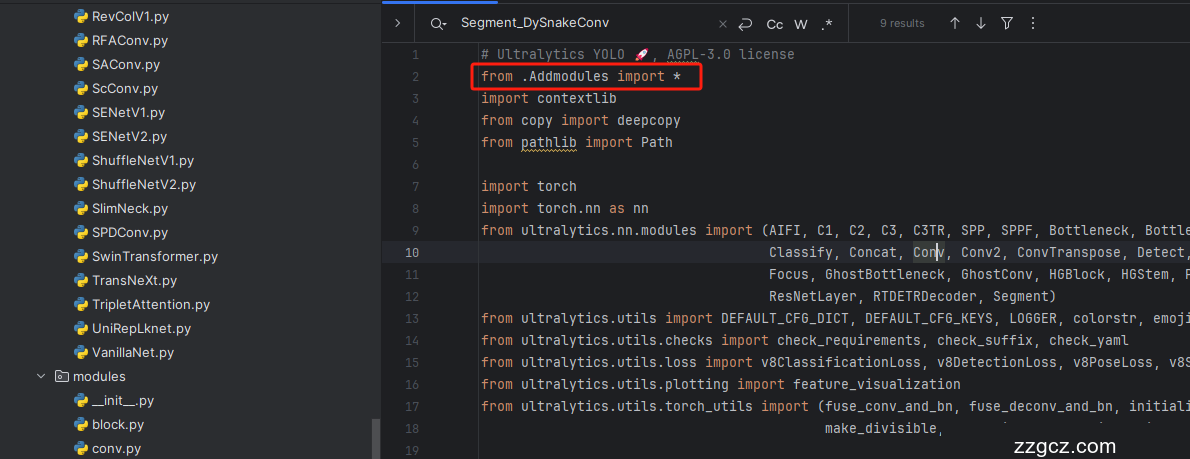
4.4 修改四
按照我的添加在parse_model里添加即可,红框内的添加即可,没有的都是其它文章里的改进机制。

到此就修改完成了,大家可以复制下面的yaml文件运行。
五、IAT的yaml文件和运行记录
5.1 IAT的yaml文件
此版本的训练信息:YOLO11-IAT summary: 435 layers, 2,681,969 parameters, 2,681,953 gradients, 24.4 GFLOPs
- # Ultralytics YOLO 🚀, AGPL-3.0 license
- # YOLO11 object detection model with P3-P5 outputs. For Usage examples see https://docs.ultralytics.com/tasks/detect
- # Parameters
- nc: 80 # number of classes
- scales: # model compound scaling constants, i.e. 'model=yolo11n.yaml' will call yolo11.yaml with scale 'n'
- # [depth, width, max_channels]
- n: [0.50, 0.25, 1024] # summary: 319 layers, 2624080 parameters, 2624064 gradients, 6.6 GFLOPs
- s: [0.50, 0.50, 1024] # summary: 319 layers, 9458752 parameters, 9458736 gradients, 21.7 GFLOPs
- m: [0.50, 1.00, 512] # summary: 409 layers, 20114688 parameters, 20114672 gradients, 68.5 GFLOPs
- l: [1.00, 1.00, 512] # summary: 631 layers, 25372160 parameters, 25372144 gradients, 87.6 GFLOPs
- x: [1.00, 1.50, 512] # summary: 631 layers, 56966176 parameters, 56966160 gradients, 196.0 GFLOPs
- # YOLO11n backbone
- backbone:
- # [from, repeats, module, args]
- - [-1, 1, IAT, []] # 0-P1/2
- - [-1, 1, Conv, [64, 3, 2]] # 1-P1/2
- - [-1, 1, Conv, [128, 3, 2]] # 2-P2/4
- - [-1, 2, C3k2, [256, False, 0.25]]
- - [-1, 1, Conv, [256, 3, 2]] # 4-P3/8
- - [-1, 2, C3k2, [512, False, 0.25]]
- - [-1, 1, Conv, [512, 3, 2]] # 6-P4/16
- - [-1, 2, C3k2, [512, True]]
- - [-1, 1, Conv, [1024, 3, 2]] # 8-P5/32
- - [-1, 2, C3k2, [1024, True]]
- - [-1, 1, SPPF, [1024, 5]] # 10
- - [-1, 2, C2PSA, [1024]] # 11
- # YOLO11n head
- head:
- - [-1, 1, nn.Upsample, [None, 2, "nearest"]]
- - [[-1, 7], 1, Concat, [1]] # cat backbone P4
- - [-1, 2, C3k2, [512, False]] # 14
- - [-1, 1, nn.Upsample, [None, 2, "nearest"]]
- - [[-1, 5], 1, Concat, [1]] # cat backbone P3
- - [-1, 2, C3k2, [256, False]] # 17 (P3/8-small)
- - [-1, 1, Conv, [256, 3, 2]]
- - [[-1, 14], 1, Concat, [1]] # cat head P4
- - [-1, 2, C3k2, [512, False]] # 20 (P4/16-medium)
- - [-1, 1, Conv, [512, 3, 2]]
- - [[-1, 11], 1, Concat, [1]] # cat head P5
- - [-1, 2, C3k2, [1024, True]] # 23 (P5/32-large)
- - [[17, 20, 23], 1, Detect, [nc]] # Detect(P3, P4, P5)
5.2 训练代码
大家可以创建一个py文件将我给的代码复制粘贴进去,配置好自己的文件路径即可运行。
- import warnings
- warnings.filterwarnings('ignore')
- from ultralytics import YOLO
- if __name__ == '__main__':
- model = YOLO('ultralytics/cfg/models/v8/yolov8-C2f-FasterBlock.yaml')
- # model.load('yolov8n.pt') # loading pretrain weights
- model.train(data=r'替换数据集yaml文件地址',
- # 如果大家任务是其它的'ultralytics/cfg/default.yaml'找到这里修改task可以改成detect, segment, classify, pose
- cache=False,
- imgsz=640,
- epochs=150,
- single_cls=False, # 是否是单类别检测
- batch=4,
- close_mosaic=10,
- workers=0,
- device='0',
- optimizer='SGD', # using SGD
- # resume='', # 如过想续训就设置last.pt的地址
- amp=False, # 如果出现训练损失为Nan可以关闭amp
- project='runs/train',
- name='exp',
- )
5.3 IAT的训练过程截图

五、本文总结
到此本文的正式分享内容就结束了,在这里给大家推荐我的YOLOv11改进有效涨点专栏,本专栏目前为新开的平均质量分98分,后期我会根据各种最新的前沿顶会进行论文复现,也会对一些老的改进机制进行补充,如果大家觉得本文帮助到你了,订阅本专栏,关注后续更多的更新~