一、本文介绍
BiFormer 是一种结合了 Bi-level Routing Attention 的视觉 Transformer 模型,BiForm er模型 的核心思想是引入了双层路由注意力机制。在BiFormer中,每个图像块都与一个位置路由器相关联。这些位置路由器根据特定的规则将图像块分配给上层和下层路由器。上层路由器负责捕捉全局上下文信息,而下层路由器则负责捕捉局部区域的细节。
具体来说,上层路由器通过全局自注意力机制对所有图像块进行交互,并生成全局图像表示。下层路由器则使用局部自注意力机制对每个图像块与其邻近的图像块进行交互,并生成局部图像表示。通过这种双层路由注意力机制,BiFormer能够同时捕捉全局和局部的特征信息,从而提高了模型在视觉任务中的 性能 (最近查看论文,发现最近有好几篇基于Biformer改进的新论文,一个是根据biformer设置了一个模块,另一个是融合了另一个机制) 。
Biformer适用检测目标-> 适合处理大尺度目标、小尺度目标、密集目标和遮挡目标的检测
二、Biformer的机制

论文地址: Biformer论文地址CSDN
代码地址: https://github.com/rayleizhu/BiFormer

在开始介绍作用机制之前,我们先来看一下 不同注意力机制的效果 。

从a-f分别是->
(a) 原始注意力: 全局操作,会产生高计算复杂度和大内存占用。
(b)-(d) 稀疏注意力 :为了减少注意力的复杂度,一些方法引入了稀疏模式,如局部窗口、轴向条纹和扩张窗口。这些模式将注意力限制在特定区域,减少了考虑的键-值对数量。
(e) 可变形注意力: 可变形注意力通过改变规则网格来实现图像自适应的稀疏性。这使得注意力机制可以集中关注输入图像的不同区域。
(f) 双层路由注意力: 所提出的方法通过双层路由实现了动态的、查询感知的稀疏性。首先确定了前k个(本例中k=3)相关区域,然后关注它们的并集。这使得注意力机制能够根据每个查询自适应地关注最有语义相关的键-值对,从而实现高效的计算。
下面来介绍作用机制-> Biformer是一种结合了Bi-level Routing Attention的视觉 Transformer模型 ,所以它具有Transformer模型的特性,其与本质上是局部操作的卷积(Conv)不同,注意力的一个关键特性是全局感受野,使得视觉Transformer能够捕捉长距离依赖关系。然而,这种特性是有代价的:由于注意力在所有空间位置上计算令牌之间的关联性,它具有较高的计算复杂度并且需要大量的内存,所以效率并不高。
为了以高效的方式全局定位有价值的键-值对进行关注,提出了一种区域到区域的路由方法。核心思想是在粗粒度的区域级别上过滤掉最不相关的键-值对,而不是直接在细粒度的标记级别上进行过滤。首先,通过构建一个区域级别的亲和度图,然后对其进行修剪,保留每个节点的前k个连接,从而实现这一点。因此,每个区域只需要关注前k个路由的区域。确定了关注的区域后,下一步是应用标记到标记的注意力,这是一个非常重要的步骤,因为现在假设键-值对在空间上是分散的。对于这种情况,虽然稀疏矩阵乘法是适用的,但在现代GPU上效率较低,因为现代GPU依赖于连续内存操作,即一次访问几十个连续字节的块。相反,我们提出了一种简单的解决方案,通过收集键/值标记来处理,其中只涉及到对于 硬件 友好的稠密矩阵乘法。我们将这种方法称为 双层路由注意力(Bi-level Routing Attention,简称BRA) ,因为它包含了一个区域级别的路由步骤和一个标记级别的注意力步骤。
总结-> 引入了一种新颖的双层路由机制来改进传统的注意力机制,以适应查询并实现内容感知的稀疏模式。利用双层路由注意力作为基本构建模块,提出了一个通用的视觉Transformer模型,名为BiFormer。在包括图像分类、目标检测和语义分割在内的各种 计算机视觉 任务上的实验结果表明,所提出的BiFormer在相似的模型大小下显著优于基准模型的性能。
2.1 Biformer的优劣势
BiFormer注意力机制的优势和劣势如下:
优势:
1. 高效的计算性能
:BiFormer利用双层路由注意力机制,在查询感知的情况下,可以以内容感知的方式关注最相关的键-值对,从而实现稀疏性。这种稀疏性减少了计算和内存开销,使得BiFormer在相同计算预算下能够实现更高的计算性能,下面我通过图片来辅助大家理解这一优势!

上图展示了通过收集前k个相关窗口中的键-值对,利用稀疏性跳过最不相关区域的计算过程,只进行适用于GPU的密集矩阵乘法运算。
在传统的注意力机制中,会对所有的键-值对进行全局的计算,导致计算复杂度较高。而在BiFormer中,通过双层路由注意力机制,只关注与查询相关的前k个窗口,并且仅进行适用于GPU的密集矩阵乘法运算。
这种做法利用了稀疏性,避免了在最不相关的区域进行冗余计算,从而提高了计算效率。只有与查询相关的键-值对参与到密集矩阵乘法运算中,减少了计算量和内存占用。
2. 查询感知的自适应性: BiFormer的双层路由注意力机制允许模型根据每个查询自适应地关注最相关的键-值对。这种自适应性使得模型能够更好地捕捉输入数据的语义关联,提高了模型的表达能力和性能。
劣势:
1. 可能存在信息损失:由于BiFormer采用了稀疏注意力机制,只关注最相关的键-值对,可能会导致一些次要的或较远的关联信息被忽略。这可能会在某些情况下导致模型性能的下降。
2. 参数调整的挑战:BiFormer的双层路由注意力机制引入了额外的参数和超参数,需要进行适当的调整和优化。这可能需要更多的实验和调试工作,以找到最佳的参数配置。
总体而言,BiFormer的注意力机制具有高效的计算性能和查询感知的自适应性,使其成为一个强大的视觉模型。然而,需要在具体任务和数据集上进行适当的实验和调整,以发挥其最佳性能。
2.2 Biformer的结构
我们通过下图来看一下Biformer的网络结构

上图展示了BiFormer的整体架构和一个BiFormer块的详细信息。
左侧:BiFormer的整体架构。该架构包括多个BiFormer块的堆叠,并且根据具体任务和需求可以进行不同的配置。BiFormer通过引入双层路由注意力机制,在每个块中实现内容感知的稀疏性,从而提高了计算性能和任务表现。
右侧:BiFormer块的详细信息。BiFormer块是BiFormer的基本构建单元,由多个子层组成。其中包括自注意力子层(self-attention)和前馈 神经网络 子层(feed-forward neural network)。自注意力子层使用双层路由注意力机制,根据查询自适应地关注最相关的键-值对。前馈神经网络子层通过多层感知机对注意力输出进行非线性变换和特征提取。这样的组合使得BiFormer具备了适应性和表达能力,能够在不同的计算机视觉任务中发挥优异的性能。
通过整体架构和BiFormer块的设计,BiFormer能够有效地利用双层路由注意力机制,实现内容感知的稀疏性,并提供灵活性和强大的表达能力,适用于各种计算机视觉任务。
到此Biformer注意力机制的理论层面以及讲解完毕,下面我们开始来在YOLOv10中添加该机制,用实战的方式帮助大家理解。
三、Biformer核心代码
核心代码的使用方式看章节四!
- from typing import Tuple, Optional
- import torch
- import torch.nn as nn
- import torch.nn.functional as F
- from einops import rearrange
- from torch import Tensor, LongTensor
- __all__ = ['BiLevelRoutingAttention', 'C2PSA_Biformer']
- class TopkRouting(nn.Module):
- """
- differentiable topk routing with scaling
- Args:
- qk_dim: int, feature dimension of query and key
- topk: int, the 'topk'
- qk_scale: int or None, temperature (multiply) of softmax activation
- with_param: bool, wether inorporate learnable params in routing unit
- diff_routing: bool, wether make routing differentiable
- soft_routing: bool, wether make output value multiplied by routing weights
- """
- def __init__(self, qk_dim, topk=4, qk_scale=None, param_routing=False, diff_routing=False):
- super().__init__()
- self.topk = topk
- self.qk_dim = qk_dim
- self.scale = qk_scale or qk_dim ** -0.5
- self.diff_routing = diff_routing
- # TODO: norm layer before/after linear?
- self.emb = nn.Linear(qk_dim, qk_dim) if param_routing else nn.Identity()
- # routing activation
- self.routing_act = nn.Softmax(dim=-1)
- def forward(self, query: Tensor, key: Tensor) -> Tuple[Tensor]:
- """
- Args:
- q, k: (n, p^2, c) tensor
- Return:
- r_weight, topk_index: (n, p^2, topk) tensor
- """
- if not self.diff_routing:
- query, key = query.detach(), key.detach()
- query_hat, key_hat = self.emb(query), self.emb(key) # per-window pooling -> (n, p^2, c)
- attn_logit = (query_hat * self.scale) @ key_hat.transpose(-2, -1) # (n, p^2, p^2)
- topk_attn_logit, topk_index = torch.topk(attn_logit, k=self.topk, dim=-1) # (n, p^2, k), (n, p^2, k)
- r_weight = self.routing_act(topk_attn_logit) # (n, p^2, k)
- return r_weight, topk_index
- class KVGather(nn.Module):
- def __init__(self, mul_weight='none'):
- super().__init__()
- assert mul_weight in ['none', 'soft', 'hard']
- self.mul_weight = mul_weight
- def forward(self, r_idx: Tensor, r_weight: Tensor, kv: Tensor):
- """
- r_idx: (n, p^2, topk) tensor
- r_weight: (n, p^2, topk) tensor
- kv: (n, p^2, w^2, c_kq+c_v)
- Return:
- (n, p^2, topk, w^2, c_kq+c_v) tensor
- """
- # select kv according to routing index
- n, p2, w2, c_kv = kv.size()
- topk = r_idx.size(-1)
- # print(r_idx.size(), r_weight.size())
- # FIXME: gather consumes much memory (topk times redundancy), write cuda kernel?
- topk_kv = torch.gather(kv.view(n, 1, p2, w2, c_kv).expand(-1, p2, -1, -1, -1),
- # (n, p^2, p^2, w^2, c_kv) without mem cpy
- dim=2,
- index=r_idx.view(n, p2, topk, 1, 1).expand(-1, -1, -1, w2, c_kv)
- # (n, p^2, k, w^2, c_kv)
- )
- if self.mul_weight == 'soft':
- topk_kv = r_weight.view(n, p2, topk, 1, 1) * topk_kv # (n, p^2, k, w^2, c_kv)
- elif self.mul_weight == 'hard':
- raise NotImplementedError('differentiable hard routing TBA')
- # else: #'none'
- # topk_kv = topk_kv # do nothing
- return topk_kv
- class QKVLinear(nn.Module):
- def __init__(self, dim, qk_dim, bias=True):
- super().__init__()
- self.dim = dim
- self.qk_dim = qk_dim
- self.qkv = nn.Linear(dim, qk_dim + qk_dim + dim, bias=bias)
- def forward(self, x):
- q, kv = self.qkv(x).split([self.qk_dim, self.qk_dim + self.dim], dim=-1)
- return q, kv
- # q, k, v = self.qkv(x).split([self.qk_dim, self.qk_dim, self.dim], dim=-1)
- # return q, k, v
- class BiLevelRoutingAttention(nn.Module):
- """
- n_win: number of windows in one side (so the actual number of windows is n_win*n_win)
- kv_per_win: for kv_downsample_mode='ada_xxxpool' only, number of key/values per window. Similar to n_win, the actual number is kv_per_win*kv_per_win.
- topk: topk for window filtering
- param_attention: 'qkvo'-linear for q,k,v and o, 'none': param free attention
- param_routing: extra linear for routing
- diff_routing: wether to set routing differentiable
- soft_routing: wether to multiply soft routing weights
- """
- def __init__(self, dim, n_win=7, num_heads=4, qk_dim=None, qk_scale=None,
- kv_per_win=4, kv_downsample_ratio=4, kv_downsample_kernel=None, kv_downsample_mode='identity',
- topk=4, param_attention="qkvo", param_routing=False, diff_routing=False, soft_routing=False,
- side_dwconv=3,
- auto_pad=True):
- super().__init__()
- # local attention setting
- self.dim = dim
- self.n_win = n_win # Wh, Ww
- self.num_heads = num_heads
- self.qk_dim = qk_dim or dim
- assert self.qk_dim % num_heads == 0 and self.dim % num_heads == 0, 'qk_dim and dim must be divisible by num_heads!'
- self.scale = qk_scale or self.qk_dim ** -0.5
- ################side_dwconv (i.e. LCE in ShuntedTransformer)###########
- self.lepe = nn.Conv2d(dim, dim, kernel_size=side_dwconv, stride=1, padding=side_dwconv // 2,
- groups=dim) if side_dwconv > 0 else \
- lambda x: torch.zeros_like(x)
- ################ global routing setting #################
- self.topk = topk
- self.param_routing = param_routing
- self.diff_routing = diff_routing
- self.soft_routing = soft_routing
- # router
- assert not (self.param_routing and not self.diff_routing) # cannot be with_param=True and diff_routing=False
- self.router = TopkRouting(qk_dim=self.qk_dim,
- qk_scale=self.scale,
- topk=self.topk,
- diff_routing=self.diff_routing,
- param_routing=self.param_routing)
- if self.soft_routing: # soft routing, always diffrentiable (if no detach)
- mul_weight = 'soft'
- elif self.diff_routing: # hard differentiable routing
- mul_weight = 'hard'
- else: # hard non-differentiable routing
- mul_weight = 'none'
- self.kv_gather = KVGather(mul_weight=mul_weight)
- # qkv mapping (shared by both global routing and local attention)
- self.param_attention = param_attention
- if self.param_attention == 'qkvo':
- self.qkv = QKVLinear(self.dim, self.qk_dim)
- self.wo = nn.Linear(dim, dim)
- elif self.param_attention == 'qkv':
- self.qkv = QKVLinear(self.dim, self.qk_dim)
- self.wo = nn.Identity()
- else:
- raise ValueError(f'param_attention mode {self.param_attention} is not surpported!')
- self.kv_downsample_mode = kv_downsample_mode
- self.kv_per_win = kv_per_win
- self.kv_downsample_ratio = kv_downsample_ratio
- self.kv_downsample_kenel = kv_downsample_kernel
- if self.kv_downsample_mode == 'ada_avgpool':
- assert self.kv_per_win is not None
- self.kv_down = nn.AdaptiveAvgPool2d(self.kv_per_win)
- elif self.kv_downsample_mode == 'ada_maxpool':
- assert self.kv_per_win is not None
- self.kv_down = nn.AdaptiveMaxPool2d(self.kv_per_win)
- elif self.kv_downsample_mode == 'maxpool':
- assert self.kv_downsample_ratio is not None
- self.kv_down = nn.MaxPool2d(self.kv_downsample_ratio) if self.kv_downsample_ratio > 1 else nn.Identity()
- elif self.kv_downsample_mode == 'avgpool':
- assert self.kv_downsample_ratio is not None
- self.kv_down = nn.AvgPool2d(self.kv_downsample_ratio) if self.kv_downsample_ratio > 1 else nn.Identity()
- elif self.kv_downsample_mode == 'identity': # no kv downsampling
- self.kv_down = nn.Identity()
- elif self.kv_downsample_mode == 'fracpool':
- # assert self.kv_downsample_ratio is not None
- # assert self.kv_downsample_kenel is not None
- # TODO: fracpool
- # 1. kernel size should be input size dependent
- # 2. there is a random factor, need to avoid independent sampling for k and v
- raise NotImplementedError('fracpool policy is not implemented yet!')
- elif kv_downsample_mode == 'conv':
- # TODO: need to consider the case where k != v so that need two downsample modules
- raise NotImplementedError('conv policy is not implemented yet!')
- else:
- raise ValueError(f'kv_down_sample_mode {self.kv_downsaple_mode} is not surpported!')
- # softmax for local attention
- self.attn_act = nn.Softmax(dim=-1)
- self.auto_pad = auto_pad
- def forward(self, x, ret_attn_mask=False):
- """
- x: NHWC tensor
- Return:
- NHWC tensor
- """
- x = rearrange(x, "n c h w -> n h w c")
- # NOTE: use padding for semantic segmentation
- ###################################################
- if self.auto_pad:
- N, H_in, W_in, C = x.size()
- pad_l = pad_t = 0
- pad_r = (self.n_win - W_in % self.n_win) % self.n_win
- pad_b = (self.n_win - H_in % self.n_win) % self.n_win
- x = F.pad(x, (0, 0, # dim=-1
- pad_l, pad_r, # dim=-2
- pad_t, pad_b)) # dim=-3
- _, H, W, _ = x.size() # padded size
- else:
- N, H, W, C = x.size()
- assert H % self.n_win == 0 and W % self.n_win == 0 #
- ###################################################
- # patchify, (n, p^2, w, w, c), keep 2d window as we need 2d pooling to reduce kv size
- x = rearrange(x, "n (j h) (i w) c -> n (j i) h w c", j=self.n_win, i=self.n_win)
- #################qkv projection###################
- # q: (n, p^2, w, w, c_qk)
- # kv: (n, p^2, w, w, c_qk+c_v)
- # NOTE: separte kv if there were memory leak issue caused by gather
- q, kv = self.qkv(x)
- # pixel-wise qkv
- # q_pix: (n, p^2, w^2, c_qk)
- # kv_pix: (n, p^2, h_kv*w_kv, c_qk+c_v)
- q_pix = rearrange(q, 'n p2 h w c -> n p2 (h w) c')
- kv_pix = self.kv_down(rearrange(kv, 'n p2 h w c -> (n p2) c h w'))
- kv_pix = rearrange(kv_pix, '(n j i) c h w -> n (j i) (h w) c', j=self.n_win, i=self.n_win)
- q_win, k_win = q.mean([2, 3]), kv[..., 0:self.qk_dim].mean(
- [2, 3]) # window-wise qk, (n, p^2, c_qk), (n, p^2, c_qk)
- ##################side_dwconv(lepe)##################
- # NOTE: call contiguous to avoid gradient warning when using ddp
- lepe = self.lepe(rearrange(kv[..., self.qk_dim:], 'n (j i) h w c -> n c (j h) (i w)', j=self.n_win,
- i=self.n_win).contiguous())
- lepe = rearrange(lepe, 'n c (j h) (i w) -> n (j h) (i w) c', j=self.n_win, i=self.n_win)
- ############ gather q dependent k/v #################
- r_weight, r_idx = self.router(q_win, k_win) # both are (n, p^2, topk) tensors
- kv_pix_sel = self.kv_gather(r_idx=r_idx, r_weight=r_weight, kv=kv_pix) # (n, p^2, topk, h_kv*w_kv, c_qk+c_v)
- k_pix_sel, v_pix_sel = kv_pix_sel.split([self.qk_dim, self.dim], dim=-1)
- # kv_pix_sel: (n, p^2, topk, h_kv*w_kv, c_qk)
- # v_pix_sel: (n, p^2, topk, h_kv*w_kv, c_v)
- ######### do attention as normal ####################
- k_pix_sel = rearrange(k_pix_sel, 'n p2 k w2 (m c) -> (n p2) m c (k w2)',
- m=self.num_heads) # flatten to BMLC, (n*p^2, m, topk*h_kv*w_kv, c_kq//m) transpose here?
- v_pix_sel = rearrange(v_pix_sel, 'n p2 k w2 (m c) -> (n p2) m (k w2) c',
- m=self.num_heads) # flatten to BMLC, (n*p^2, m, topk*h_kv*w_kv, c_v//m)
- q_pix = rearrange(q_pix, 'n p2 w2 (m c) -> (n p2) m w2 c',
- m=self.num_heads) # to BMLC tensor (n*p^2, m, w^2, c_qk//m)
- # param-free multihead attention
- attn_weight = (
- q_pix * self.scale) @ k_pix_sel # (n*p^2, m, w^2, c) @ (n*p^2, m, c, topk*h_kv*w_kv) -> (n*p^2, m, w^2, topk*h_kv*w_kv)
- attn_weight = self.attn_act(attn_weight)
- out = attn_weight @ v_pix_sel # (n*p^2, m, w^2, topk*h_kv*w_kv) @ (n*p^2, m, topk*h_kv*w_kv, c) -> (n*p^2, m, w^2, c)
- out = rearrange(out, '(n j i) m (h w) c -> n (j h) (i w) (m c)', j=self.n_win, i=self.n_win,
- h=H // self.n_win, w=W // self.n_win)
- out = out + lepe
- # output linear
- out = self.wo(out)
- # NOTE: use padding for semantic segmentation
- # crop padded region
- if self.auto_pad and (pad_r > 0 or pad_b > 0):
- out = out[:, :H_in, :W_in, :].contiguous()
- if ret_attn_mask:
- return out, r_weight, r_idx, attn_weight
- else:
- return rearrange(out, "n h w c -> n c h w")
- def autopad(k, p=None, d=1): # kernel, padding, dilation
- """Pad to 'same' shape outputs."""
- if d > 1:
- k = d * (k - 1) + 1 if isinstance(k, int) else [d * (x - 1) + 1 for x in k] # actual kernel-size
- if p is None:
- p = k // 2 if isinstance(k, int) else [x // 2 for x in k] # auto-pad
- return p
- class Conv(nn.Module):
- """Standard convolution with args(ch_in, ch_out, kernel, stride, padding, groups, dilation, activation)."""
- default_act = nn.SiLU() # default activation
- def __init__(self, c1, c2, k=1, s=1, p=None, g=1, d=1, act=True):
- """Initialize Conv layer with given arguments including activation."""
- super().__init__()
- self.conv = nn.Conv2d(c1, c2, k, s, autopad(k, p, d), groups=g, dilation=d, bias=False)
- self.bn = nn.BatchNorm2d(c2)
- self.act = self.default_act if act is True else act if isinstance(act, nn.Module) else nn.Identity()
- def forward(self, x):
- """Apply convolution, batch normalization and activation to input tensor."""
- return self.act(self.bn(self.conv(x)))
- def forward_fuse(self, x):
- """Perform transposed convolution of 2D data."""
- return self.act(self.conv(x))
- class PSABlock(nn.Module):
- """
- PSABlock class implementing a Position-Sensitive Attention block for neural networks.
- This class encapsulates the functionality for applying multi-head attention and feed-forward neural network layers
- with optional shortcut connections.
- Attributes:
- attn (Attention): Multi-head attention module.
- ffn (nn.Sequential): Feed-forward neural network module.
- add (bool): Flag indicating whether to add shortcut connections.
- Methods:
- forward: Performs a forward pass through the PSABlock, applying attention and feed-forward layers.
- Examples:
- Create a PSABlock and perform a forward pass
- >>> psablock = PSABlock(c=128, attn_ratio=0.5, num_heads=4, shortcut=True)
- >>> input_tensor = torch.randn(1, 128, 32, 32)
- >>> output_tensor = psablock(input_tensor)
- """
- def __init__(self, c, attn_ratio=0.5, num_heads=4, shortcut=True) -> None:
- """Initializes the PSABlock with attention and feed-forward layers for enhanced feature extraction."""
- super().__init__()
- self.attn = BiLevelRoutingAttention(c)
- self.ffn = nn.Sequential(Conv(c, c * 2, 1), Conv(c * 2, c, 1, act=False))
- self.add = shortcut
- def forward(self, x):
- """Executes a forward pass through PSABlock, applying attention and feed-forward layers to the input tensor."""
- x = x + self.attn(x) if self.add else self.attn(x)
- x = x + self.ffn(x) if self.add else self.ffn(x)
- return x
- class C2PSA_Biformer(nn.Module):
- """
- C2PSA module with attention mechanism for enhanced feature extraction and processing.
- This module implements a convolutional block with attention mechanisms to enhance feature extraction and processing
- capabilities. It includes a series of PSABlock modules for self-attention and feed-forward operations.
- Attributes:
- c (int): Number of hidden channels.
- cv1 (Conv): 1x1 convolution layer to reduce the number of input channels to 2*c.
- cv2 (Conv): 1x1 convolution layer to reduce the number of output channels to c.
- m (nn.Sequential): Sequential container of PSABlock modules for attention and feed-forward operations.
- Methods:
- forward: Performs a forward pass through the C2PSA module, applying attention and feed-forward operations.
- Notes:
- This module essentially is the same as PSA module, but refactored to allow stacking more PSABlock modules.
- """
- def __init__(self, c1, c2, n=1, e=0.5):
- """Initializes the C2PSA module with specified input/output channels, number of layers, and expansion ratio."""
- super().__init__()
- assert c1 == c2
- self.c = int(c1 * e)
- self.cv1 = Conv(c1, 2 * self.c, 1, 1)
- self.cv2 = Conv(2 * self.c, c1, 1)
- self.m = nn.Sequential(*(PSABlock(self.c, attn_ratio=0.5, num_heads=self.c // 64) for _ in range(n)))
- def forward(self, x):
- """Processes the input tensor 'x' through a series of PSA blocks and returns the transformed tensor."""
- a, b = self.cv1(x).split((self.c, self.c), dim=1)
- b = self.m(b)
- return self.cv2(torch.cat((a, b), 1))
- if __name__ == "__main__":
- # Generating Sample image
- image_size = (1, 64, 240, 240)
- image = torch.rand(*image_size)
- # Model
- mobilenet_v1 = C2PSA_Biformer(64, 64)
- out = mobilenet_v1(image)
- print(out.size())
四、添加Biformer注意力机制
4.1 修改一
第一还是建立文件,我们找到如下 ultralytics /nn文件夹下建立一个目录名字呢就是'Addmodules'文件夹( 用群内的文件的话已经有了无需新建) !然后在其内部建立一个新的py文件将核心代码复制粘贴进去即可。

4.2 修改二
第二步我们在该目录下创建一个新的py文件名字为'__init__.py'( 用群内的文件的话已经有了无需新建) ,然后在其内部导入我们的检测头如下图所示。

4.3 修改三
第三步我门中到如下文件'ultralytics/nn/tasks.py'进行导入和注册我们的模块( 用群内的文件的话已经有了无需重新导入直接开始第四步即可) !
从今天开始以后的教程就都统一成这个样子了,因为我默认大家用了我群内的文件来进行修改!!
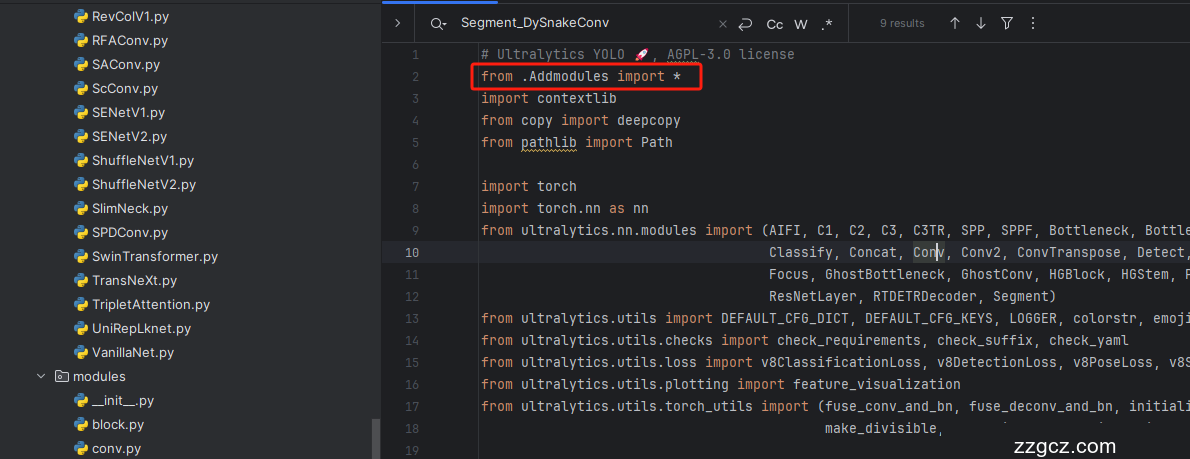
4.4 修改四
按照我的添加在parse_model里添加即可,两个图片都是本文的机制大家按照图片进行添加即可!

到此就修改完成了,大家可以复制下面的yaml文件运行。
4.2 Biformer的yaml文件和训练截图
4.2.1 Biformer的yaml版本一(推荐)
此版本训练信息:YOLO11-C2PSA-Biformer summary: 318 layers, 2,610,715 parameters, 2,610,699 gradients, 9.0 GFLOPs
版本说明:优化C2PSA注意力机制
- # Ultralytics YOLO 🚀, AGPL-3.0 license
- # YOLO11 object detection model with P3-P5 outputs. For Usage examples see https://docs.ultralytics.com/tasks/detect
- # Parameters
- nc: 80 # number of classes
- scales: # model compound scaling constants, i.e. 'model=yolo11n.yaml' will call yolo11.yaml with scale 'n'
- # [depth, width, max_channels]
- n: [0.50, 0.25, 1024] # summary: 319 layers, 2624080 parameters, 2624064 gradients, 6.6 GFLOPs
- s: [0.50, 0.50, 1024] # summary: 319 layers, 9458752 parameters, 9458736 gradients, 21.7 GFLOPs
- m: [0.50, 1.00, 512] # summary: 409 layers, 20114688 parameters, 20114672 gradients, 68.5 GFLOPs
- l: [1.00, 1.00, 512] # summary: 631 layers, 25372160 parameters, 25372144 gradients, 87.6 GFLOPs
- x: [1.00, 1.50, 512] # summary: 631 layers, 56966176 parameters, 56966160 gradients, 196.0 GFLOPs
- # YOLO11n backbone
- backbone:
- # [from, repeats, module, args]
- - [-1, 1, Conv, [64, 3, 2]] # 0-P1/2
- - [-1, 1, Conv, [128, 3, 2]] # 1-P2/4
- - [-1, 2, C3k2, [256, False, 0.25]]
- - [-1, 1, Conv, [256, 3, 2]] # 3-P3/8
- - [-1, 2, C3k2, [512, False, 0.25]]
- - [-1, 1, Conv, [512, 3, 2]] # 5-P4/16
- - [-1, 2, C3k2, [512, True]]
- - [-1, 1, Conv, [1024, 3, 2]] # 7-P5/32
- - [-1, 2, C3k2, [1024, True]]
- - [-1, 1, SPPF, [1024, 5]] # 9
- - [-1, 2, C2PSA_Biformer, [1024]] # 10
- # YOLO11n head
- head:
- - [-1, 1, nn.Upsample, [None, 2, "nearest"]]
- - [[-1, 6], 1, Concat, [1]] # cat backbone P4
- - [-1, 2, C3k2, [512, False]] # 13
- - [-1, 1, nn.Upsample, [None, 2, "nearest"]]
- - [[-1, 4], 1, Concat, [1]] # cat backbone P3
- - [-1, 2, C3k2, [256, False]] # 16 (P3/8-small)
- - [-1, 1, Conv, [256, 3, 2]]
- - [[-1, 13], 1, Concat, [1]] # cat head P4
- - [-1, 2, C3k2, [512, False]] # 19 (P4/16-medium)
- - [-1, 1, Conv, [512, 3, 2]]
- - [[-1, 10], 1, Concat, [1]] # cat head P5
- - [-1, 2, C3k2, [1024, True]] # 22 (P5/32-large)
- - [[16, 19, 22], 1, Detect, [nc]] # Detect(P3, P4, P5)
4.2.2 Biformer的yaml版本二
添加的版本二具体那种适合你需要大家自己多做实验来尝试。
此版本训练信息:YOLO11-Biformer summary: 352 layers, 2,945,051 parameters, 2,945,035 gradients, 7.3 GFLOPs
- # Ultralytics YOLO 🚀, AGPL-3.0 license
- # YOLO11 object detection model with P3-P5 outputs. For Usage examples see https://docs.ultralytics.com/tasks/detect
- # Parameters
- nc: 80 # number of classes
- scales: # model compound scaling constants, i.e. 'model=yolo11n.yaml' will call yolo11.yaml with scale 'n'
- # [depth, width, max_channels]
- n: [0.50, 0.25, 1024] # summary: 319 layers, 2624080 parameters, 2624064 gradients, 6.6 GFLOPs
- s: [0.50, 0.50, 1024] # summary: 319 layers, 9458752 parameters, 9458736 gradients, 21.7 GFLOPs
- m: [0.50, 1.00, 512] # summary: 409 layers, 20114688 parameters, 20114672 gradients, 68.5 GFLOPs
- l: [1.00, 1.00, 512] # summary: 631 layers, 25372160 parameters, 25372144 gradients, 87.6 GFLOPs
- x: [1.00, 1.50, 512] # summary: 631 layers, 56966176 parameters, 56966160 gradients, 196.0 GFLOPs
- # YOLO11n backbone
- backbone:
- # [from, repeats, module, args]
- - [-1, 1, Conv, [64, 3, 2]] # 0-P1/2
- - [-1, 1, Conv, [128, 3, 2]] # 1-P2/4
- - [-1, 2, C3k2, [256, False, 0.25]]
- - [-1, 1, Conv, [256, 3, 2]] # 3-P3/8
- - [-1, 2, C3k2, [512, False, 0.25]]
- - [-1, 1, Conv, [512, 3, 2]] # 5-P4/16
- - [-1, 2, C3k2, [512, True]]
- - [-1, 1, Conv, [1024, 3, 2]] # 7-P5/32
- - [-1, 2, C3k2, [1024, True]]
- - [-1, 1, SPPF, [1024, 5]] # 9
- - [-1, 2, C2PSA, [1024]] # 10
- # YOLO11n head
- head:
- - [-1, 1, nn.Upsample, [None, 2, "nearest"]]
- - [[-1, 6], 1, Concat, [1]] # cat backbone P4
- - [-1, 2, C3k2, [512, False]] # 13
- - [-1, 1, nn.Upsample, [None, 2, "nearest"]]
- - [[-1, 4], 1, Concat, [1]] # cat backbone P3
- - [-1, 2, C3k2, [256, False]] # 16 (P3/8-small)
- - [-1, 1, BiLevelRoutingAttention, []] # 17 (P3/8-small) 小目标检测层输出位置增加注意力机制
- - [-1, 1, Conv, [256, 3, 2]]
- - [[-1, 13], 1, Concat, [1]] # cat head P4
- - [-1, 2, C3k2, [512, False]] # 20 (P4/16-medium)
- - [-1, 1, BiLevelRoutingAttention, []] # 21 (P4/16-medium) 中目标检测层输出位置增加注意力机制
- - [-1, 1, Conv, [512, 3, 2]]
- - [[-1, 10], 1, Concat, [1]] # cat head P5
- - [-1, 2, C3k2, [1024, True]] # 24 (P5/32-large)
- - [-1, 1, BiLevelRoutingAttention, []] # 25 (P5/32-large) 大目标检测层输出位置增加注意力机制
- # 具体在那一层用注意力机制可以根据自己的数据集场景进行选择。
- # 如果你自己配置注意力位置注意from[17, 21, 25]位置要对应上对应的检测层!
- - [[17, 21, 25], 1, Detect, [nc]] # Detect(P3, P4, P5)
4.4 Biformer的训练过程截图

4.5 训练代码
- import warnings
- warnings.filterwarnings('ignore')
- from ultralytics import YOLO
- if __name__ == '__main__':
- model = YOLO('模型yaml文件地址')
- # 如何切换模型版本, 上面的ymal文件可以改为 yolov8s.yaml就是使用的v8s,
- # 类似某个改进的yaml文件名称为yolov8-XXX.yaml那么如果想使用其它版本就把上面的名称改为yolov8l-XXX.yaml即可(改的是上面YOLO中间的名字不是配置文件的)!
- # model.load('yolov8n.pt') # 是否加载预训练权重,科研不建议大家加载否则很难提升精度
- model.train(data=r"填写你数据集yaml文件地址",
- # 如果大家任务是其它的'ultralytics/cfg/default.yaml'找到这里修改task可以改成detect, segment, classify, pose
- cache=False,
- imgsz=640,
- epochs=150,
- single_cls=False, # 是否是单类别检测
- batch=4,
- close_mosaic=0,
- workers=0,
- device='0',
- optimizer='SGD', # using SGD
- # resume=True, # 这里是填写True
- amp=False, # 如果出现训练损失为Nan可以关闭amp
- project='runs/train',
- name='exp',
- )
五、本文总结
到此本文的正式分享内容就结束了,在这里给大家推荐我的YOLOv11改进有效涨点专栏,本专栏目前为新开的平均质量分98分,后期我会根据各种最新的前沿顶会进行论文复现,也会对一些老的改进机制进行补充, 目前本专栏免费阅读(暂时,大家尽早关注不迷路~) ,如果大家觉得本文帮助到你了,订阅本专栏,关注后续更多的更新~
