一、本文介绍
本文给大家带来的改进机制是 2024最新的 ,Kolmogorov-Arnold 网络(Convolutional KANs),这种架构旨在将 Kolmogorov-Arnold 网络(KANs)的非线性激活 函数 整合到 卷积层 中,从而替代传统 卷积神经网络 (CNNs)的线性变换。与标准的卷积神经网络(CNN)相比,KANConv 层引入了更多的参数,因为每个卷积核元素都需要额外的可学习函数。这使得它能够更好地捕捉数据中的空间关系。在实验中,KANConv 层在图像识别等任务中常常表现出比传统卷积层更高的精度,特别是当网络架构经过精心优化时。 同时博主帮大家整理了多大九种的不同类型激活函数 KANConv2d,总有一种适合你的数据集 , 包含:
二、原理介绍

官方论文地址: 官方论文地址点击此处即可跳转
官方代码地址: 官方代码地址点击此处即可跳转

文章提出了卷积柯尔莫哥洛夫-阿诺德网络(Convolutional KANs) ,这是结合了柯尔莫哥洛夫-阿诺德网络(KANs)的非线性 激活函数 与卷积神经网络(CNNs)的创新架构。卷积KANs通过使用可学习的样条函数替代传统CNN中的固定激活函数和线性卷积操作,在保持 模型 准确率的同时大幅减少了参数数量。这种方法为优化 神经网络 架构、提升参数效率提供了新途径。

1. 背景和动机
- 深度学习尤其是在计算机视觉领域的进展依赖于越来越复杂的神经网络架构。传统的CNNs通过线性卷积操作处理图像数据,但这些方法在处理复杂非线性数据时有一定的局限性。
- 柯尔莫哥洛夫-阿诺德网络(KANs)是一种新的架构,它利用柯尔莫哥洛夫-阿诺德定理,将多变量函数表示为单变量函数的组合,通过可学习的样条来增强模型的表达能力。
2. KANs的应用
- KANs通过用可学习的样条函数代替传统神经网络的线性权重矩阵,使网络在保持或提高准确率的同时减少参数数量。
- 这些样条函数的可学习性让KANs在复杂数据上具有更好的灵活性和表达能力。
3. 卷积KANs的实现
- 卷积KANs结合了KANs的优势与卷积神经网络的架构,将KANs的样条函数应用于卷积操作中。
- 卷积KANs的卷积核由可学习的非线性函数(例如B样条)组成,而不是传统CNN中固定的权重。这些函数根据训练数据动态调整形状,以更好地适应数据的非线性特征。
4. 参数效率
- 卷积KANs显著减少了所需的参数数量 (我实验之后基本都是增加,和文章描述的不符) 。例如,在MNIST和Fashion-MNIST数据集上 (看到这两个数据集的时候我对文章的结果和这个结构得有效性产生了一定的质疑) ,卷积KANs使用的参数数量比传统CNN减少了一半,而准确率基本相同。
- 减少的参数数量不仅有助于提高训练速度和内存效率,还可能提升模型的泛化能力。
5. 实验结果
- 通过对MNIST和Fashion-MNIST数据集的实验,卷积KANs显示出与传统CNN相似的准确率,但参数数量显著减少。
- 当使用更少的参数时,卷积KANs在某些情况下甚至超过了传统卷积模型的性能,证明了其在处理非线性关系方面的优势。
总结: 卷积 Kolmogorov-Arnold 网络(Convolutional KANs),这是一种对标准卷积神经网络(CNNs)的创新替代方法,后者已经彻底改变了 计算机视觉 领域。将 Kolmogorov-Arnold 网络(KANs)中提出的非线性激活函数整合到卷积操作中,构建了一个新的网络层。在整篇论文中,作者通过 MNIST 和 Fashion-MNIST 基准数据集对卷积 KANs 的性能进行了实证验证,结果显示,这种新方法在保持类似准确率的同时,参数数量减少了一半。这种参数的大幅减少为神经网络架构的优化开辟了一种新的途径。


三、核心代码
核心代码涉及到1200行,包含九个版本的KANConv2d,其中有两个存在一定问题'WavKANConv2d' 需要大量显存(我个人电脑8g显存运行不了) 'KANConv2d'需要torch 1.9以上。
- from functools import lru_cache
- import torch
- import torch.nn as nn
- import torch.nn.functional as F
- from einops import einsum
- import numpy as np
- import math
- from torch.autograd import Function
- __all__ = ['RBFKANConv2d', 'ReLUKANConv2d', 'KANConv2d', 'FasterKANConv2d', 'WavKANConv2d', 'ChebyKANConv2d', 'JacobiKANConv2d', 'FastKANConv2d', 'GRAMKANConv2d']
- # ################################################各种工具###########################################################
- class RadialBasisFunction(nn.Module):
- def __init__(
- self,
- grid_min: float = -2.,
- grid_max: float = 2.,
- num_grids: int = 8,
- denominator: float = None, # larger denominators lead to smoother basis
- ):
- super().__init__()
- grid = torch.linspace(grid_min, grid_max, num_grids)
- self.grid = torch.nn.Parameter(grid, requires_grad=False)
- self.denominator = denominator or (grid_max - grid_min) / (num_grids - 1)
- def forward(self, x):
- return torch.exp(-((x[..., None] - self.grid) / self.denominator) ** 2)
- class RSWAFFunction(Function):
- @staticmethod
- def forward(ctx, input, grid, inv_denominator, train_grid, train_inv_denominator):
- # Compute the forward pass
- # print('\n')
- # print(f"Forward pass - grid: {(grid[0].item(),grid[-1].item())}, inv_denominator: {inv_denominator.item()}")
- # print(f"grid.shape: {grid.shape }")
- # print(f"grid: {(grid[0],grid[-1]) }")
- # print(f"inv_denominator.shape: {inv_denominator.shape }")
- # print(f"inv_denominator: {inv_denominator }")
- diff = (input[..., None] - grid)
- diff_mul = diff.mul(inv_denominator)
- tanh_diff = torch.tanh(diff)
- tanh_diff_deriviative = -tanh_diff.mul(tanh_diff) + 1 # sech^2(x) = 1 - tanh^2(x)
- # Save tensors for backward pass
- ctx.save_for_backward(input, tanh_diff, tanh_diff_deriviative, diff, inv_denominator)
- ctx.train_grid = train_grid
- ctx.train_inv_denominator = train_inv_denominator
- return tanh_diff_deriviative
- @staticmethod
- def backward(ctx, grad_output):
- # Retrieve saved tensors
- input, tanh_diff, tanh_diff_deriviative, diff, inv_denominator = ctx.saved_tensors
- grad_grid = None
- grad_inv_denominator = None
- # print(f"tanh_diff_deriviative shape: {tanh_diff_deriviative.shape }")
- # print(f"tanh_diff shape: {tanh_diff.shape }")
- # print(f"grad_output shape: {grad_output.shape }")
- # Compute the backward pass for the input
- grad_input = -2 * tanh_diff * tanh_diff_deriviative * grad_output
- # print(f"Backward pass 1 - grad_input: {(grad_input.min().item(), grad_input.max().item())}")
- # print(f"grad_input shape: {grad_input.shape }")
- # print(f"grad_input.sum(dim=-1): {grad_input.sum(dim=-1).shape}")
- grad_input = grad_input.sum(dim=-1).mul(inv_denominator)
- # print(f"Backward pass 2 - grad_input: {(grad_input.min().item(), grad_input.max().item())}")
- # print(f"grad_input: {grad_input}")
- # print(f"grad_input shape: {grad_input.shape }")
- # Compute the backward pass for grid
- if ctx.train_grid:
- # print('\n')
- # print(f"grad_grid shape: {grad_grid.shape }")
- grad_grid = -inv_denominator * grad_output.sum(dim=0).sum(
- dim=0) # -(inv_denominator * grad_output * tanh_diff_deriviative).sum(dim=0) #-inv_denominator * grad_output.sum(dim=0).sum(dim=0)
- # print(f"Backward pass - grad_grid: {(grad_grid[0].item(),grad_grid[-1].item())}")
- # print(f"grad_grid.shape: {grad_grid.shape }")
- # print(f"grad_grid: {(grad_grid[0],grad_grid[-1]) }")
- # print(f"inv_denominator shape: {inv_denominator.shape }")
- # print(f"grad_grid shape: {grad_grid.shape }")
- # Compute the backward pass for inv_denominator
- if ctx.train_inv_denominator:
- grad_inv_denominator = (
- grad_output * diff).sum() # (grad_output * diff * tanh_diff_deriviative).sum() #(grad_output* diff).sum()
- # print(f"Backward pass - grad_inv_denominator: {grad_inv_denominator.item()}")
- # print(f"diff shape: {diff.shape }")
- # print(f"grad_inv_denominator shape: {grad_inv_denominator.shape }")
- # print(f"grad_inv_denominator : {grad_inv_denominator }")
- return grad_input, grad_grid, grad_inv_denominator, None, None # same number as tensors or parameters
- class ReflectionalSwitchFunction(nn.Module):
- def __init__(
- self,
- grid_min: float = -1.2,
- grid_max: float = 0.2,
- num_grids: int = 8,
- exponent: int = 2,
- inv_denominator: float = 0.5,
- train_grid: bool = False,
- train_inv_denominator: bool = False,
- ):
- super().__init__()
- grid = torch.linspace(grid_min, grid_max, num_grids)
- self.train_grid = torch.tensor(train_grid, dtype=torch.bool)
- self.train_inv_denominator = torch.tensor(train_inv_denominator, dtype=torch.bool)
- self.grid = torch.nn.Parameter(grid, requires_grad=train_grid)
- # print(f"grid initial shape: {self.grid.shape }")
- self.inv_denominator = torch.nn.Parameter(torch.tensor(inv_denominator, dtype=torch.float32),
- requires_grad=train_inv_denominator) # Cache the inverse of the denominator
- def forward(self, x):
- return RSWAFFunction.apply(x, self.grid, self.inv_denominator, self.train_grid, self.train_inv_denominator)
- # ####################################各种激活函数##############################################################
- class KANLayer(nn.Module):
- def __init__(self, input_features, output_features, grid_size=5, spline_order=3, base_activation=nn.GELU,
- grid_range=[-1, 1]):
- super(KANLayer, self).__init__()
- self.input_features = input_features
- self.output_features = output_features
- # The number of points in the grid for the spline interpolation.
- self.grid_size = grid_size
- # The order of the spline used in the interpolation.
- self.spline_order = spline_order
- # Activation function used for the initial transformation of the input.
- self.base_activation = base_activation()
- # The range of values over which the grid for spline interpolation is defined.
- self.grid_range = grid_range
- # Initialize the base weights with random values for the linear transformation.
- self.base_weight = nn.Parameter(torch.randn(output_features, input_features))
- # Initialize the spline weights with random values for the spline transformation.
- self.spline_weight = nn.Parameter(torch.randn(output_features, input_features, grid_size + spline_order))
- # Add a layer normalization for stabilizing the output of this layer.
- self.layer_norm = nn.LayerNorm(output_features)
- # Add a PReLU activation for this layer to provide a learnable non-linearity.
- self.prelu = nn.PReLU()
- # Compute the grid values based on the specified range and grid size.
- h = (self.grid_range[1] - self.grid_range[0]) / grid_size
- self.grid = torch.linspace(
- self.grid_range[0] - h * spline_order,
- self.grid_range[1] + h * spline_order,
- grid_size + 2 * spline_order + 1,
- dtype=torch.float32
- ).expand(input_features, -1).contiguous()
- # Initialize the weights using Kaiming uniform distribution for better initial values.
- nn.init.kaiming_uniform_(self.base_weight, nonlinearity='linear')
- nn.init.kaiming_uniform_(self.spline_weight, nonlinearity='linear')
- def forward(self, x):
- # Process each layer using the defined base weights, spline weights, norms, and activations.
- grid = self.grid.to(x.device)
- # Move the input tensor to the device where the weights are located.
- # Perform the base linear transformation followed by the activation function.
- base_output = F.linear(self.base_activation(x), self.base_weight)
- x_uns = x.unsqueeze(-1) # Expand dimensions for spline operations.
- # Compute the basis for the spline using intervals and input values.
- bases = ((x_uns >= grid[:, :-1]) & (x_uns < grid[:, 1:])).to(x.dtype).to(x.device)
- # Compute the spline basis over multiple orders.
- for k in range(1, self.spline_order + 1):
- left_intervals = grid[:, :-(k + 1)]
- right_intervals = grid[:, k:-1]
- delta = torch.where(right_intervals == left_intervals, torch.ones_like(right_intervals),
- right_intervals - left_intervals)
- bases = ((x_uns - left_intervals) / delta * bases[:, :, :-1]) + \
- ((grid[:, k + 1:] - x_uns) / (grid[:, k + 1:] - grid[:, 1:(-k)]) * bases[:, :, 1:])
- bases = bases.contiguous()
- # Compute the spline transformation and combine it with the base transformation.
- spline_output = F.linear(bases.view(x.size(0), -1), self.spline_weight.view(self.spline_weight.size(0), -1))
- # Apply layer normalization and PReLU activation to the combined output.
- x = self.prelu(self.layer_norm(base_output + spline_output))
- return x
- class SplineLinear(nn.Linear):
- def __init__(self, in_features: int, out_features: int, init_scale: float = 0.1, **kw) -> None:
- self.init_scale = init_scale
- super().__init__(in_features, out_features, bias=False, **kw)
- def reset_parameters(self) -> None:
- nn.init.trunc_normal_(self.weight, mean=0, std=self.init_scale)
- class FastKANLayer(nn.Module):
- def __init__(
- self,
- input_dim: int,
- output_dim: int,
- grid_min: float = -2.,
- grid_max: float = 2.,
- num_grids: int = 8,
- use_base_update: bool = True,
- base_activation=nn.SiLU,
- spline_weight_init_scale: float = 0.1,
- ) -> None:
- super().__init__()
- self.layernorm = nn.LayerNorm(input_dim)
- self.rbf = RadialBasisFunction(grid_min, grid_max, num_grids)
- self.spline_linear = SplineLinear(input_dim * num_grids, output_dim, spline_weight_init_scale)
- self.use_base_update = use_base_update
- if use_base_update:
- self.base_activation = base_activation()
- self.base_linear = nn.Linear(input_dim, output_dim)
- def forward(self, x, time_benchmark=False):
- if not time_benchmark:
- spline_basis = self.rbf(self.layernorm(x))
- else:
- spline_basis = self.rbf(x)
- ret = self.spline_linear(spline_basis.view(*spline_basis.shape[:-2], -1))
- if self.use_base_update:
- base = self.base_linear(self.base_activation(x))
- ret = ret + base
- return ret
- # This is inspired by Kolmogorov-Arnold Networks but using Chebyshev polynomials instead of splines coefficients
- class ChebyKANLayer(nn.Module):
- def __init__(self, input_dim, output_dim, degree):
- super(ChebyKANLayer, self).__init__()
- self.inputdim = input_dim
- self.outdim = output_dim
- self.degree = degree
- self.cheby_coeffs = nn.Parameter(torch.empty(input_dim, output_dim, degree + 1))
- nn.init.normal_(self.cheby_coeffs, mean=0.0, std=1 / (input_dim * (degree + 1)))
- self.register_buffer("arange", torch.arange(0, degree + 1, 1))
- def forward(self, x):
- # Since Chebyshev polynomial is defined in [-1, 1]
- # We need to normalize x to [-1, 1] using tanh
- # x = torch.tanh(x)
- x = torch.clamp(x, -1.0, 1.0)
- # View and repeat input degree + 1 times
- x = x.view((-1, self.inputdim, 1)).expand(
- -1, -1, self.degree + 1
- ) # shape = (batch_size, inputdim, self.degree + 1)
- # Apply acos
- x = x.acos()
- # Multiply by arange [0 .. degree]
- x *= self.arange
- # Apply cos
- x = x.cos()
- # Compute the Chebyshev interpolation
- y = torch.einsum(
- "bid,iod->bo", x, self.cheby_coeffs
- ) # shape = (batch_size, outdim)
- y = y.view(-1, self.outdim)
- return y
- class GRAMLayer(nn.Module):
- def __init__(self, in_channels, out_channels, degree=3, act=nn.SiLU):
- super(GRAMLayer, self).__init__()
- self.in_channels = in_channels
- self.out_channels = out_channels
- self.degrees = degree
- self.act = act()
- self.norm = nn.LayerNorm(out_channels).to(dtype=torch.float32)
- self.beta_weights = nn.Parameter(torch.zeros(degree + 1, dtype=torch.float32))
- self.grams_basis_weights = nn.Parameter(
- torch.zeros(in_channels, out_channels, degree + 1, dtype=torch.float32)
- )
- self.base_weights = nn.Parameter(
- torch.zeros(out_channels, in_channels, dtype=torch.float32)
- )
- self.init_weights()
- def init_weights(self):
- nn.init.normal_(
- self.beta_weights,
- mean=0.0,
- std=1.0 / (self.in_channels * (self.degrees + 1.0)),
- )
- nn.init.xavier_uniform_(self.grams_basis_weights)
- nn.init.xavier_uniform_(self.base_weights)
- def beta(self, n, m):
- return (
- ((m + n) * (m - n) * n ** 2) / (m ** 2 / (4.0 * n ** 2 - 1.0))
- ) * self.beta_weights[n]
- @lru_cache(maxsize=128)
- def gram_poly(self, x, degree):
- p0 = x.new_ones(x.size())
- if degree == 0:
- return p0.unsqueeze(-1)
- p1 = x
- grams_basis = [p0, p1]
- for i in range(2, degree + 1):
- p2 = x * p1 - self.beta(i - 1, i) * p0
- grams_basis.append(p2)
- p0, p1 = p1, p2
- return torch.stack(grams_basis, dim=-1)
- def forward(self, x):
- basis = F.linear(self.act(x), self.base_weights)
- x = torch.tanh(x).contiguous()
- grams_basis = self.act(self.gram_poly(x, self.degrees))
- y = einsum(
- grams_basis,
- self.grams_basis_weights,
- "b l d, l o d -> b o",
- )
- y = self.act(self.norm(y + basis))
- y = y.view(-1, self.out_channels)
- return y
- class WavKANLayer(nn.Module):
- def __init__(self, in_features, out_features, wavelet_type='mexican_hat'):
- super(WavKANLayer, self).__init__()
- self.in_features = in_features
- self.out_features = out_features
- self.wavelet_type = wavelet_type
- # Parameters for wavelet transformation
- self.scale = nn.Parameter(torch.ones(out_features, in_features))
- self.translation = nn.Parameter(torch.zeros(out_features, in_features))
- # Linear weights for combining outputs
- # self.weight = nn.Parameter(torch.Tensor(out_features, in_features))
- self.weight1 = nn.Parameter(torch.Tensor(out_features,
- in_features)) # not used; you may like to use it for wieghting base activation and adding it like Spl-KAN paper
- self.wavelet_weights = nn.Parameter(torch.Tensor(out_features, in_features))
- nn.init.kaiming_uniform_(self.wavelet_weights, a=math.sqrt(5))
- nn.init.kaiming_uniform_(self.weight1, a=math.sqrt(5))
- # Base activation function #not used for this experiment
- self.base_activation = nn.SiLU()
- # Batch normalization
- self.bn = nn.BatchNorm1d(out_features)
- def wavelet_transform(self, x):
- if x.dim() == 2:
- x_expanded = x.unsqueeze(1)
- else:
- x_expanded = x
- translation_expanded = self.translation.unsqueeze(0).expand(x.size(0), -1, -1)
- scale_expanded = self.scale.unsqueeze(0).expand(x.size(0), -1, -1)
- x_scaled = (x_expanded - translation_expanded) / scale_expanded
- # Implementation of different wavelet types
- if self.wavelet_type == 'mexican_hat':
- term1 = ((x_scaled ** 2) - 1)
- term2 = torch.exp(-0.5 * x_scaled ** 2)
- wavelet = (2 / (math.sqrt(3) * math.pi ** 0.25)) * term1 * term2
- elif self.wavelet_type == 'morlet':
- omega0 = 5.0 # Central frequency
- real = torch.cos(omega0 * x_scaled)
- envelope = torch.exp(-0.5 * x_scaled ** 2)
- wavelet = envelope * real
- elif self.wavelet_type == 'dog':
- # Implementing Derivative of Gaussian Wavelet
- wavelet = -x_scaled * torch.exp(-0.5 * x_scaled ** 2)
- elif self.wavelet_type == 'meyer':
- # Implement Meyer Wavelet here
- # Constants for the Meyer wavelet transition boundaries
- v = torch.abs(x_scaled)
- pi = math.pi
- def meyer_aux(v):
- return torch.where(v <= 1 / 2, torch.ones_like(v),
- torch.where(v >= 1, torch.zeros_like(v), torch.cos(pi / 2 * nu(2 * v - 1))))
- def nu(t):
- return t ** 4 * (35 - 84 * t + 70 * t ** 2 - 20 * t ** 3)
- # Meyer wavelet calculation using the auxiliary function
- wavelet = torch.sin(pi * v) * meyer_aux(v)
- elif self.wavelet_type == 'shannon':
- # Windowing the sinc function to limit its support
- pi = math.pi
- sinc = torch.sinc(x_scaled / pi) # sinc(x) = sin(pi*x) / (pi*x)
- # Applying a Hamming window to limit the infinite support of the sinc function
- window = torch.hamming_window(x_scaled.size(-1), periodic=False, dtype=x_scaled.dtype,
- device=x_scaled.device)
- # Shannon wavelet is the product of the sinc function and the window
- wavelet = sinc * window
- # You can try many more wavelet types ...
- else:
- raise ValueError("Unsupported wavelet type")
- wavelet_weighted = wavelet * self.wavelet_weights.unsqueeze(0).expand_as(wavelet)
- wavelet_output = wavelet_weighted.sum(dim=2)
- return wavelet_output
- def forward(self, x):
- wavelet_output = self.wavelet_transform(x)
- # You may like test the cases like Spl-KAN
- # wav_output = F.linear(wavelet_output, self.weight)
- base_output = F.linear(self.base_activation(x), self.weight1)
- # base_output = F.linear(x, self.weight1)
- combined_output = wavelet_output + base_output
- # Apply batch normalization
- return self.bn(combined_output)
- class JacobiKANLayer(nn.Module):
- def __init__(self, input_dim, output_dim, degree, a=1.0, b=1.0, act=nn.SiLU):
- super(JacobiKANLayer, self).__init__()
- self.inputdim = input_dim
- self.outdim = output_dim
- self.a = a
- self.b = b
- self.degree = degree
- self.act = act()
- self.norm = nn.LayerNorm(output_dim,).to(dtype=torch.float32)
- self.base_weights = nn.Parameter(
- torch.zeros(output_dim, input_dim, dtype=torch.float32)
- )
- self.jacobi_coeffs = nn.Parameter(torch.empty(input_dim, output_dim, degree + 1))
- nn.init.normal_(self.jacobi_coeffs, mean=0.0, std=1 / (input_dim * (degree + 1)))
- nn.init.xavier_uniform_(self.base_weights)
- def forward(self, x):
- x = torch.reshape(x, (-1, self.inputdim)) # shape = (batch_size, inputdim)
- basis = F.linear(self.act(x), self.base_weights)
- # Since Jacobian polynomial is defined in [-1, 1]
- # We need to normalize x to [-1, 1] using tanh
- x = torch.tanh(x)
- # Initialize Jacobian polynomial tensors
- jacobi = torch.ones(x.shape[0], self.inputdim, self.degree + 1, device=x.device)
- if self.degree > 0: ## degree = 0: jacobi[:, :, 0] = 1 (already initialized) ; degree = 1: jacobi[:, :, 1] = x ; d
- jacobi[:, :, 1] = ((self.a - self.b) + (self.a + self.b + 2) * x) / 2
- for i in range(2, self.degree + 1):
- theta_k = (2 * i + self.a + self.b) * (2 * i + self.a + self.b - 1) / (2 * i * (i + self.a + self.b))
- theta_k1 = (2 * i + self.a + self.b - 1) * (self.a * self.a - self.b * self.b) / (
- 2 * i * (i + self.a + self.b) * (2 * i + self.a + self.b - 2))
- theta_k2 = (i + self.a - 1) * (i + self.b - 1) * (2 * i + self.a + self.b) / (
- i * (i + self.a + self.b) * (2 * i + self.a + self.b - 2))
- jacobi[:, :, i] = (theta_k * x + theta_k1) * jacobi[:, :, i - 1].clone() - theta_k2 * jacobi[:, :,
- i - 2].clone()
- # Compute the Jacobian interpolation
- y = torch.einsum('bid,iod->bo', jacobi, self.jacobi_coeffs) # shape = (batch_size, outdim)
- y = y.view(-1, self.outdim)
- y = self.act(self.norm(y + basis))
- return y
- class ReLUKANLayer(nn.Module):
- def __init__(self, input_size: int, g: int, k: int, output_size: int, train_ab: bool = True):
- super().__init__()
- self.g, self.k, self.r = g, k, 4 * g * g / ((k + 1) * (k + 1))
- self.input_size, self.output_size = input_size, output_size
- phase_low = np.arange(-k, g) / g
- phase_height = phase_low + (k + 1) / g
- self.phase_low = nn.Parameter(torch.Tensor(np.array([phase_low for i in range(input_size)])),
- requires_grad=train_ab)
- self.phase_height = nn.Parameter(torch.Tensor(np.array([phase_height for i in range(input_size)])),
- requires_grad=train_ab)
- self.equal_size_conv = nn.Conv2d(1, output_size, (g + k, input_size))
- def forward(self, x):
- # Expand dimensions of x to match the shape of self.phase_low
- x_expanded = x.unsqueeze(2).expand(-1, -1, self.phase_low.size(1))
- # Perform the subtraction with broadcasting
- x1 = torch.relu(x_expanded - self.phase_low)
- x2 = torch.relu(self.phase_height - x_expanded)
- # Continue with the rest of the operations
- x = x1 * x2 * self.r
- x = x * x
- x = x.reshape((len(x), 1, self.g + self.k, self.input_size))
- x = self.equal_size_conv(x)
- # x = x.reshape((len(x), self.output_size, 1))
- x = x.reshape((len(x), self.output_size))
- return x
- class SplineLinear_fstr(nn.Linear):
- def __init__(self, in_features: int, out_features: int, init_scale: float = 0.1, **kw) -> None:
- self.init_scale = init_scale
- super().__init__(in_features, out_features, bias=False, **kw)
- def reset_parameters(self) -> None:
- nn.init.xavier_uniform_(self.weight) # Using Xavier Uniform initialization
- class FasterKANLayer(nn.Module):
- def __init__(
- self,
- input_dim: int,
- output_dim: int,
- grid_min: float = -1.2,
- grid_max: float = 0.2,
- num_grids: int = 8,
- exponent: int = 2,
- inv_denominator: float = 0.5,
- train_grid: bool = False,
- train_inv_denominator: bool = False,
- # use_base_update: bool = True,
- base_activation=F.silu,
- spline_weight_init_scale: float = 0.667,
- ) -> None:
- super().__init__()
- self.layernorm = nn.LayerNorm(input_dim)
- self.rbf = ReflectionalSwitchFunction(grid_min, grid_max, num_grids, exponent, inv_denominator, train_grid,
- train_inv_denominator)
- self.spline_linear = SplineLinear_fstr(input_dim * num_grids, output_dim, spline_weight_init_scale)
- # self.use_base_update = use_base_update
- # if use_base_update:
- # self.base_activation = base_activation
- # self.base_linear = nn.Linear(input_dim, output_dim)
- def forward(self, x):
- # print("Shape before LayerNorm:", x.shape) # Debugging line to check the input shape
- x = self.layernorm(x)
- # print("Shape After LayerNorm:", x.shape)
- spline_basis = self.rbf(x).view(x.shape[0], -1)
- # print("spline_basis:", spline_basis.shape)
- # print("-------------------------")
- # ret = 0
- ret = self.spline_linear(spline_basis)
- # print("spline_basis.shape[:-2]:", spline_basis.shape[:-2])
- # print("*spline_basis.shape[:-2]:", *spline_basis.shape[:-2])
- # print("spline_basis.view(*spline_basis.shape[:-2], -1):", spline_basis.view(*spline_basis.shape[:-2], -1).shape)
- # print("ret:", ret.shape)
- # print("-------------------------")
- # if self.use_base_update:
- # base = self.base_linear(self.base_activation(x))
- # print("self.base_activation(x):", self.base_activation(x).shape)
- # print("base:", base.shape)
- # print("@@@@@@@@@")
- # ret += base
- return ret
- class RBFLinear(nn.Module):
- def __init__(self, in_features, out_features, grid_min=-2., grid_max=2., num_grids=8, spline_weight_init_scale=0.1):
- super().__init__()
- self.grid_min = grid_min
- self.grid_max = grid_max
- self.num_grids = num_grids
- self.grid = nn.Parameter(torch.linspace(grid_min, grid_max, num_grids), requires_grad=False)
- self.spline_weight = nn.Parameter(torch.randn(in_features * num_grids, out_features) * spline_weight_init_scale)
- def forward(self, x):
- x = x.unsqueeze(-1)
- basis = torch.exp(-((x - self.grid) / ((self.grid_max - self.grid_min) / (self.num_grids - 1))) ** 2)
- return basis.reshape(basis.size(0), -1).matmul(self.spline_weight)
- class RBFKANLayer(nn.Module):
- def __init__(self, input_dim, output_dim, grid_min=-2., grid_max=2., num_grids=8, use_base_update=True,
- base_activation=nn.SiLU(), spline_weight_init_scale=0.1):
- super().__init__()
- self.input_dim = input_dim
- self.output_dim = output_dim
- self.use_base_update = use_base_update
- self.base_activation = base_activation
- self.spline_weight_init_scale = spline_weight_init_scale
- self.rbf_linear = RBFLinear(input_dim, output_dim, grid_min, grid_max, num_grids, spline_weight_init_scale)
- self.base_linear = nn.Linear(input_dim, output_dim) if use_base_update else None
- def forward(self, x):
- ret = self.rbf_linear(x)
- if self.use_base_update:
- base = self.base_linear(self.base_activation(x))
- ret = ret + base
- return ret
- class KANLinear(torch.nn.Module):
- def __init__(
- self,
- in_features,
- out_features,
- grid_size=5,
- spline_order=3,
- scale_noise=0.1,
- scale_base=1.0,
- scale_spline=1.0,
- enable_standalone_scale_spline=True,
- base_activation=torch.nn.SiLU,
- grid_eps=0.02,
- grid_range=[-1, 1],
- ):
- super(KANLinear, self).__init__()
- self.in_features = in_features
- self.out_features = out_features
- self.grid_size = grid_size
- self.spline_order = spline_order
- h = (grid_range[1] - grid_range[0]) / grid_size
- grid = (
- (
- torch.arange(-spline_order, grid_size + spline_order + 1) * h
- + grid_range[0]
- )
- .expand(in_features, -1)
- .contiguous()
- )
- self.register_buffer("grid", grid)
- self.base_weight = torch.nn.Parameter(torch.Tensor(out_features, in_features))
- self.spline_weight = torch.nn.Parameter(
- torch.Tensor(out_features, in_features, grid_size + spline_order)
- )
- if enable_standalone_scale_spline:
- self.spline_scaler = torch.nn.Parameter(
- torch.Tensor(out_features, in_features)
- )
- self.scale_noise = scale_noise
- self.scale_base = scale_base
- self.scale_spline = scale_spline
- self.enable_standalone_scale_spline = enable_standalone_scale_spline
- self.base_activation = base_activation()
- self.grid_eps = grid_eps
- self.reset_parameters()
- def reset_parameters(self):
- torch.nn.init.kaiming_uniform_(self.base_weight, a=math.sqrt(5) * self.scale_base)
- with torch.no_grad():
- noise = (
- (
- torch.rand(self.grid_size + 1, self.in_features, self.out_features)
- - 1 / 2
- )
- * self.scale_noise
- / self.grid_size
- )
- self.spline_weight.data.copy_(
- (self.scale_spline if not self.enable_standalone_scale_spline else 1.0)
- * self.curve2coeff(
- self.grid.T[self.spline_order: -self.spline_order],
- noise,
- )
- )
- if self.enable_standalone_scale_spline:
- # torch.nn.init.constant_(self.spline_scaler, self.scale_spline)
- torch.nn.init.kaiming_uniform_(self.spline_scaler, a=math.sqrt(5) * self.scale_spline)
- def b_splines(self, x: torch.Tensor):
- """
- Compute the B-spline bases for the given input tensor.
- Args:
- x (torch.Tensor): Input tensor of shape (batch_size, in_features).
- Returns:
- torch.Tensor: B-spline bases tensor of shape (batch_size, in_features, grid_size + spline_order).
- """
- assert x.dim() == 2 and x.size(1) == self.in_features
- grid: torch.Tensor = (
- self.grid
- ) # (in_features, grid_size + 2 * spline_order + 1)
- x = x.unsqueeze(-1)
- bases = ((x >= grid[:, :-1]) & (x < grid[:, 1:])).to(x.dtype)
- for k in range(1, self.spline_order + 1):
- bases = (
- (x - grid[:, : -(k + 1)])
- / (grid[:, k:-1] - grid[:, : -(k + 1)])
- * bases[:, :, :-1]
- ) + (
- (grid[:, k + 1:] - x)
- / (grid[:, k + 1:] - grid[:, 1:(-k)])
- * bases[:, :, 1:]
- )
- assert bases.size() == (
- x.size(0),
- self.in_features,
- self.grid_size + self.spline_order,
- )
- return bases.contiguous()
- def curve2coeff(self, x: torch.Tensor, y: torch.Tensor):
- """
- Compute the coefficients of the curve that interpolates the given points.
- Args:
- x (torch.Tensor): Input tensor of shape (batch_size, in_features).
- y (torch.Tensor): Output tensor of shape (batch_size, in_features, out_features).
- Returns:
- torch.Tensor: Coefficients tensor of shape (out_features, in_features, grid_size + spline_order).
- """
- assert x.dim() == 2 and x.size(1) == self.in_features
- assert y.size() == (x.size(0), self.in_features, self.out_features)
- A = self.b_splines(x).transpose(
- 0, 1
- ) # (in_features, batch_size, grid_size + spline_order)
- B = y.transpose(0, 1) # (in_features, batch_size, out_features)
- # CSDN作者Snu77注明 此处torch.linalg.lstsq需要torch1.9及以上才可以.
- solution = torch.linalg.lstsq(
- A, B
- ).solution # (in_features, grid_size + spline_order, out_features)
- result = solution.permute(
- 2, 0, 1
- ) # (out_features, in_features, grid_size + spline_order)
- assert result.size() == (
- self.out_features,
- self.in_features,
- self.grid_size + self.spline_order,
- )
- return result.contiguous()
- @property
- def scaled_spline_weight(self):
- return self.spline_weight * (
- self.spline_scaler.unsqueeze(-1)
- if self.enable_standalone_scale_spline
- else 1.0
- )
- def forward(self, x: torch.Tensor):
- assert x.dim() == 2 and x.size(1) == self.in_features
- base_output = F.linear(self.base_activation(x), self.base_weight)
- spline_output = F.linear(
- self.b_splines(x).view(x.size(0), -1),
- self.scaled_spline_weight.view(self.out_features, -1),
- )
- return base_output + spline_output
- @torch.no_grad()
- def update_grid(self, x: torch.Tensor, margin=0.01):
- assert x.dim() == 2 and x.size(1) == self.in_features
- batch = x.size(0)
- splines = self.b_splines(x) # (batch, in, coeff)
- splines = splines.permute(1, 0, 2) # (in, batch, coeff)
- orig_coeff = self.scaled_spline_weight # (out, in, coeff)
- orig_coeff = orig_coeff.permute(1, 2, 0) # (in, coeff, out)
- unreduced_spline_output = torch.bmm(splines, orig_coeff) # (in, batch, out)
- unreduced_spline_output = unreduced_spline_output.permute(
- 1, 0, 2
- ) # (batch, in, out)
- # sort each channel individually to collect data distribution
- x_sorted = torch.sort(x, dim=0)[0]
- grid_adaptive = x_sorted[
- torch.linspace(
- 0, batch - 1, self.grid_size + 1, dtype=torch.int64, device=x.device
- )
- ]
- uniform_step = (x_sorted[-1] - x_sorted[0] + 2 * margin) / self.grid_size
- grid_uniform = (
- torch.arange(
- self.grid_size + 1, dtype=torch.float32, device=x.device
- ).unsqueeze(1)
- * uniform_step
- + x_sorted[0]
- - margin
- )
- grid = self.grid_eps * grid_uniform + (1 - self.grid_eps) * grid_adaptive
- grid = torch.concatenate(
- [
- grid[:1]
- - uniform_step
- * torch.arange(self.spline_order, 0, -1, device=x.device).unsqueeze(1),
- grid,
- grid[-1:]
- + uniform_step
- * torch.arange(1, self.spline_order + 1, device=x.device).unsqueeze(1),
- ],
- dim=0,
- )
- self.grid.copy_(grid.T)
- self.spline_weight.data.copy_(self.curve2coeff(x, unreduced_spline_output))
- def regularization_loss(self, regularize_activation=1.0, regularize_entropy=1.0):
- """
- Compute the regularization loss.
- This is a dumb simulation of the original L1 regularization as stated in the
- paper, since the original one requires computing absolutes and entropy from the
- expanded (batch, in_features, out_features) intermediate tensor, which is hidden
- behind the F.linear function if we want an memory efficient implementation.
- The L1 regularization is now computed as mean absolute value of the spline
- weights. The authors implementation also includes this term in addition to the
- sample-based regularization.
- """
- l1_fake = self.spline_weight.abs().mean(-1)
- regularization_loss_activation = l1_fake.sum()
- p = l1_fake / regularization_loss_activation
- regularization_loss_entropy = -torch.sum(p * p.log())
- return (
- regularize_activation * regularization_loss_activation
- + regularize_entropy * regularization_loss_entropy
- )
- # """""""""""""""""""""""""""""""""""""""""""""正式代码"""""""""""""""""""""""""""""""""""""""""""
- class KANConv2d(nn.Module):
- def __init__(self, in_channels, out_channels, kernel_size, stride=1, padding=1):
- super(KANConv2d, self).__init__()
- self.in_channels = in_channels
- self.out_channels = out_channels
- self.kernel_size = kernel_size
- self.stride = stride
- self.padding = padding
- self.kanlayer = KANLinear(in_channels * kernel_size * kernel_size, out_channels)
- def forward(self, x):
- batch_size, in_channels, height, width = x.size()
- assert in_channels == self.in_channels
- # Apply unfold to get sliding local blocks
- x_unfold = F.unfold(x, kernel_size=self.kernel_size, stride=self.stride, padding=self.padding)
- x_unfold = x_unfold.transpose(1, 2)
- x_unfold = x_unfold.reshape(batch_size * x_unfold.size(1), -1)
- out_unfold = self.kanlayer(x_unfold)
- # Reshape and transpose to get the final output
- out_unfold = out_unfold.reshape(batch_size, -1, out_unfold.size(1))
- out = out_unfold.transpose(1, 2)
- out_height = (height + 2 * self.padding - self.kernel_size) // self.stride + 1
- out_width = (width + 2 * self.padding - self.kernel_size) // self.stride + 1
- out = out.reshape(batch_size, self.out_channels, out_height, out_width)
- return out
- class ChebyKANConv2d(nn.Module):
- def __init__(self, in_channels, out_channels, kernel_size, stride=1, padding=1, degree=4):
- super(ChebyKANConv2d, self).__init__()
- self.in_channels = in_channels
- self.out_channels = out_channels
- self.kernel_size = kernel_size
- self.stride = stride
- self.padding = padding
- self.kanlayer = ChebyKANLayer(in_channels * kernel_size * kernel_size, out_channels, degree=degree)
- def forward(self, x):
- batch_size, in_channels, height, width = x.size()
- assert in_channels == self.in_channels
- # Apply unfold to get sliding local blocks
- x_unfold = F.unfold(x, kernel_size=self.kernel_size, stride=self.stride, padding=self.padding)
- x_unfold = x_unfold.transpose(1, 2)
- x_unfold = x_unfold.reshape(batch_size * x_unfold.size(1), -1)
- out_unfold = self.kanlayer(x_unfold)
- # Reshape and transpose to get the final output
- out_unfold = out_unfold.reshape(batch_size, -1, out_unfold.size(1))
- out = out_unfold.transpose(1, 2)
- out_height = (height + 2 * self.padding - self.kernel_size) // self.stride + 1
- out_width = (width + 2 * self.padding - self.kernel_size) // self.stride + 1
- out = out.reshape(batch_size, self.out_channels, out_height, out_width)
- return out
- class FastKANConv2d(nn.Module):
- def __init__(self, in_channels, out_channels, kernel_size, stride=1, padding=1):
- super(FastKANConv2d, self).__init__()
- self.in_channels = in_channels
- self.out_channels = out_channels
- self.kernel_size = kernel_size
- self.stride = stride
- self.padding = padding
- self.kanlayer = FastKANLayer(in_channels * kernel_size * kernel_size, out_channels)
- def forward(self, x):
- batch_size, in_channels, height, width = x.size()
- assert in_channels == self.in_channels
- # Apply unfold to get sliding local blocks
- x_unfold = F.unfold(x, kernel_size=self.kernel_size, stride=self.stride, padding=self.padding)
- x_unfold = x_unfold.transpose(1, 2)
- x_unfold = x_unfold.reshape(batch_size * x_unfold.size(1), -1)
- out_unfold = self.kanlayer(x_unfold)
- # Reshape and transpose to get the final output
- out_unfold = out_unfold.reshape(batch_size, -1, out_unfold.size(1))
- out = out_unfold.transpose(1, 2)
- out_height = (height + 2 * self.padding - self.kernel_size) // self.stride + 1
- out_width = (width + 2 * self.padding - self.kernel_size) // self.stride + 1
- out = out.reshape(batch_size, self.out_channels, out_height, out_width)
- return out
- class GRAMKANConv2d(nn.Module):
- def __init__(self, in_channels, out_channels, kernel_size, stride=1, padding=1):
- super(GRAMKANConv2d, self).__init__()
- self.in_channels = in_channels
- self.out_channels = out_channels
- self.kernel_size = kernel_size
- self.stride = stride
- self.padding = padding
- self.kanlayer = GRAMLayer(in_channels * kernel_size * kernel_size, out_channels)
- def forward(self, x):
- batch_size, in_channels, height, width = x.size()
- assert in_channels == self.in_channels
- # Apply unfold to get sliding local blocks
- x_unfold = F.unfold(x, kernel_size=self.kernel_size, stride=self.stride, padding=self.padding)
- x_unfold = x_unfold.transpose(1, 2)
- x_unfold = x_unfold.reshape(batch_size * x_unfold.size(1), -1)
- out_unfold = self.kanlayer(x_unfold)
- # Reshape and transpose to get the final output
- out_unfold = out_unfold.reshape(batch_size, -1, out_unfold.size(1))
- out = out_unfold.transpose(1, 2)
- out_height = (height + 2 * self.padding - self.kernel_size) // self.stride + 1
- out_width = (width + 2 * self.padding - self.kernel_size) // self.stride + 1
- out = out.reshape(batch_size, self.out_channels, out_height, out_width)
- return out
- class WavKANConv2d(nn.Module):
- def __init__(self, in_channels, out_channels, kernel_size, stride=1, padding=1, wavelet_type='mexican_hat'):
- super(WavKANConv2d, self).__init__()
- self.in_channels = in_channels
- self.out_channels = out_channels
- self.kernel_size = kernel_size
- self.stride = stride
- self.padding = padding
- self.kanlayer = WavKANLayer(in_channels * kernel_size * kernel_size, out_channels, wavelet_type=wavelet_type)
- def forward(self, x):
- batch_size, in_channels, height, width = x.size()
- assert in_channels == self.in_channels
- # Apply unfold to get sliding local blocks
- x_unfold = F.unfold(x, kernel_size=self.kernel_size, stride=self.stride, padding=self.padding)
- x_unfold = x_unfold.transpose(1, 2)
- x_unfold = x_unfold.reshape(batch_size * x_unfold.size(1), -1)
- out_unfold = self.kanlayer(x_unfold)
- # Reshape and transpose to get the final output
- out_unfold = out_unfold.reshape(batch_size, -1, out_unfold.size(1))
- out = out_unfold.transpose(1, 2)
- out_height = (height + 2 * self.padding - self.kernel_size) // self.stride + 1
- out_width = (width + 2 * self.padding - self.kernel_size) // self.stride + 1
- out = out.reshape(batch_size, self.out_channels, out_height, out_width)
- return out
- class JacobiKANConv2d(nn.Module):
- def __init__(self, in_channels, out_channels, kernel_size, stride=1, padding=1,degree=4):
- super(JacobiKANConv2d, self).__init__()
- self.in_channels = in_channels
- self.out_channels = out_channels
- self.kernel_size = kernel_size
- self.stride = stride
- self.padding = padding
- self.kanlayer = JacobiKANLayer(in_channels * kernel_size * kernel_size, out_channels, degree=degree)
- def forward(self, x):
- batch_size, in_channels, height, width = x.size()
- assert in_channels == self.in_channels
- # Apply unfold to get sliding local blocks
- x_unfold = F.unfold(x, kernel_size=self.kernel_size, stride=self.stride, padding=self.padding)
- x_unfold = x_unfold.transpose(1, 2)
- x_unfold = x_unfold.reshape(batch_size * x_unfold.size(1), -1)
- out_unfold = self.kanlayer(x_unfold)
- # Reshape and transpose to get the final output
- out_unfold = out_unfold.reshape(batch_size, -1, out_unfold.size(1))
- out = out_unfold.transpose(1, 2)
- out_height = (height + 2 * self.padding - self.kernel_size) // self.stride + 1
- out_width = (width + 2 * self.padding - self.kernel_size) // self.stride + 1
- out = out.reshape(batch_size, self.out_channels, out_height, out_width)
- return out
- class ReLUKANConv2d(nn.Module):
- def __init__(self, in_channels, out_channels, kernel_size, stride=1, padding=1):
- super(ReLUKANConv2d, self).__init__()
- self.in_channels = in_channels
- self.out_channels = out_channels
- self.kernel_size = kernel_size
- self.stride = stride
- self.padding = padding
- self.kanlayer = ReLUKANLayer(in_channels * kernel_size * kernel_size, 5, 3, out_channels)
- def forward(self, x):
- batch_size, in_channels, height, width = x.size()
- assert in_channels == self.in_channels
- # Apply unfold to get sliding local blocks
- x_unfold = F.unfold(x, kernel_size=self.kernel_size, stride=self.stride, padding=self.padding)
- x_unfold = x_unfold.transpose(1, 2)
- x_unfold = x_unfold.reshape(batch_size * x_unfold.size(1), -1)
- out_unfold = self.kanlayer(x_unfold)
- # Reshape and transpose to get the final output
- out_unfold = out_unfold.reshape(batch_size, -1, out_unfold.size(1))
- out = out_unfold.transpose(1, 2)
- out_height = (height + 2 * self.padding - self.kernel_size) // self.stride + 1
- out_width = (width + 2 * self.padding - self.kernel_size) // self.stride + 1
- out = out.reshape(batch_size, self.out_channels, out_height, out_width)
- return out
- class FasterKANConv2d(nn.Module):
- def __init__(self, in_channels, out_channels, kernel_size, stride=1, padding=1):
- super(FasterKANConv2d, self).__init__()
- self.in_channels = in_channels
- self.out_channels = out_channels
- self.kernel_size = kernel_size
- self.stride = stride
- self.padding = padding
- self.kanlayer = FasterKANLayer(in_channels * kernel_size * kernel_size, out_channels)
- def forward(self, x):
- batch_size, in_channels, height, width = x.size()
- assert in_channels == self.in_channels
- # Apply unfold to get sliding local blocks
- x_unfold = F.unfold(x, kernel_size=self.kernel_size, stride=self.stride, padding=self.padding)
- x_unfold = x_unfold.transpose(1, 2)
- x_unfold = x_unfold.reshape(batch_size * x_unfold.size(1), -1)
- out_unfold = self.kanlayer(x_unfold)
- # Reshape and transpose to get the final output
- out_unfold = out_unfold.reshape(batch_size, -1, out_unfold.size(1))
- out = out_unfold.transpose(1, 2)
- out_height = (height + 2 * self.padding - self.kernel_size) // self.stride + 1
- out_width = (width + 2 * self.padding - self.kernel_size) // self.stride + 1
- out = out.reshape(batch_size, self.out_channels, out_height, out_width)
- return out
- class RBFKANConv2d(nn.Module):
- def __init__(self, in_channels, out_channels, kernel_size, stride=1, padding=1):
- super(RBFKANConv2d, self).__init__()
- self.in_channels = in_channels
- self.out_channels = out_channels
- self.kernel_size = kernel_size
- self.stride = stride
- self.padding = padding
- self.kanlayer = RBFKANLayer(in_channels * kernel_size * kernel_size, out_channels)
- def forward(self, x):
- batch_size, in_channels, height, width = x.size()
- assert in_channels == self.in_channels
- # Apply unfold to get sliding local blocks
- x_unfold = F.unfold(x, kernel_size=self.kernel_size, stride=self.stride, padding=self.padding)
- x_unfold = x_unfold.transpose(1, 2)
- x_unfold = x_unfold.reshape(batch_size * x_unfold.size(1), -1)
- out_unfold = self.kanlayer(x_unfold)
- # Reshape and transpose to get the final output
- out_unfold = out_unfold.reshape(batch_size, -1, out_unfold.size(1))
- out = out_unfold.transpose(1, 2)
- out_height = (height + 2 * self.padding - self.kernel_size) // self.stride + 1
- out_width = (width + 2 * self.padding - self.kernel_size) // self.stride + 1
- out = out.reshape(batch_size, self.out_channels, out_height, out_width)
- return out
- if __name__ == "__main__":
- # Generating Sample image
- image_size = (1, 64, 240, 240)
- image = torch.rand(*image_size)
- # KANConv2d需要torch1.9以上才可以.
- Convs = ['RBFKANConv2d', 'ReLUKANConv2d','FasterKANConv2d', 'ChebyKANConv2d', 'JacobiKANConv2d', 'FastKANConv2d', 'GRAMKANConv2d']
- qu = ['WavKANConv2d'] # 需要大量显存
- e = ['KANConv2d'] # 需要torch 1.9以上
- with torch.no_grad():
- for i in range(len(Convs)):
- model = eval(Convs[i])
- # Model
- mobilenet_v1 = model(64, 64, kernel_size=3, stride=1, padding=1)
- out = mobilenet_v1(image)
- print(out.size())
四、手把手教你添加九种KANCon2d
4.1 步骤一
首先我们找到如下的目录' ultralytics /nn',然后在这个目录下创建一个py文件,名字可以根据你自己的习惯起,然后将核心代码复制进去。

4.2 步骤二
第二步我们在该目录下创建一个新的py文件名字为'__init__.py'( 用群内的文件的话已经有了无需新建) ,然后在其内部导入我们的检测头如下图所示。

4.3 步骤三
第三步我门中到如下文件'ultralytics/nn/tasks.py'进行导入和注册我们的模块( 用群内的文件的话已经有了无需重新导入直接开始第四步即可) !
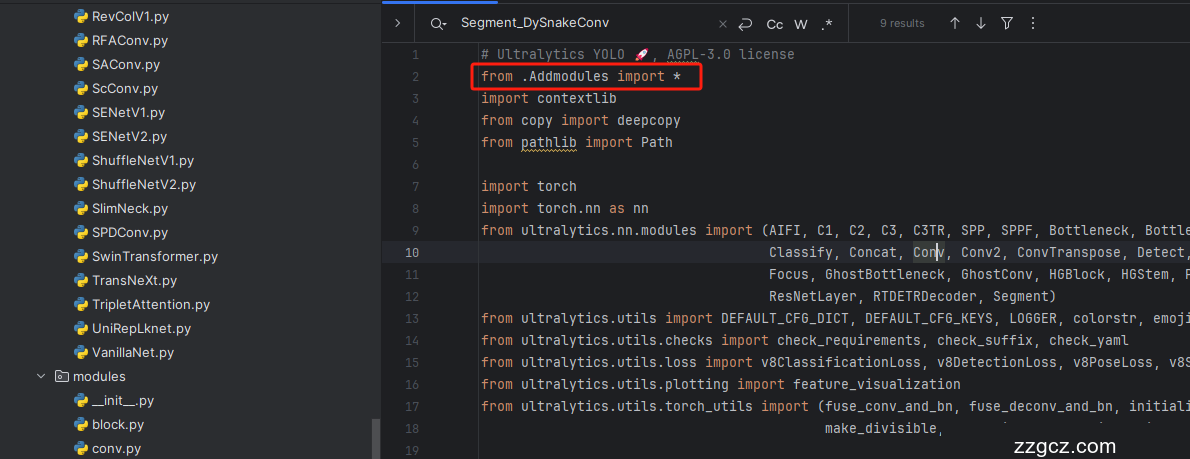
4.4 步骤四
我们找到parse_model这个方法,可以用搜索 (Ctrl + F) 也可以自己手动找, 我们找到如下的地方,模仿我添加即可。

到此我们就注册成功了,接下里的是复制yaml文件,然后运行文件。
五、九种KANCon2d的yaml文件
九种KANConv2d分别是:WavKANConv2d, RBFKANConv2d, KANConv2d, ReLUKANConv2d, FasterKANConv2d, ChebyKANConv2d, JacobiKANConv2d, FastKANConv2d, GRAMKANConv2d.
5.1 RBFKANConv2d 的yaml文件
此版本训练信息:YOLO11-RBFKANConv2d summary: 326 layers, 7,935,471 parameters, 7,935,407 gradients, 6.4 GFLOP
- # Ultralytics YOLO 🚀, AGPL-3.0 license
- # YOLO11 object detection model with P3-P5 outputs. For Usage examples see https://docs.ultralytics.com/tasks/detect
- # Parameters
- nc: 80 # number of classes
- scales: # model compound scaling constants, i.e. 'model=yolo11n.yaml' will call yolo11.yaml with scale 'n'
- # [depth, width, max_channels]
- n: [0.50, 0.25, 1024] # summary: 319 layers, 2624080 parameters, 2624064 gradients, 6.6 GFLOPs
- s: [0.50, 0.50, 1024] # summary: 319 layers, 9458752 parameters, 9458736 gradients, 21.7 GFLOPs
- m: [0.50, 1.00, 512] # summary: 409 layers, 20114688 parameters, 20114672 gradients, 68.5 GFLOPs
- l: [1.00, 1.00, 512] # summary: 631 layers, 25372160 parameters, 25372144 gradients, 87.6 GFLOPs
- x: [1.00, 1.50, 512] # summary: 631 layers, 56966176 parameters, 56966160 gradients, 196.0 GFLOPs
- # YOLO11n backbone
- backbone:
- # [from, repeats, module, args]
- - [-1, 1, Conv, [64, 3, 2]] # 0-P1/2
- - [-1, 1, RBFKANConv2d, [128, 3, 2]] # 1-P2/4
- - [-1, 2, C3k2, [256, False, 0.25]]
- - [-1, 1, RBFKANConv2d, [256, 3, 2]] # 3-P3/8
- - [-1, 2, C3k2, [512, False, 0.25]]
- - [-1, 1, RBFKANConv2d, [512, 3, 2]] # 5-P4/16
- - [-1, 2, C3k2, [512, True]]
- - [-1, 1, RBFKANConv2d, [1024, 3, 2]] # 7-P5/32
- - [-1, 2, C3k2, [1024, True]]
- - [-1, 1, SPPF, [1024, 5]] # 9
- - [-1, 2, C2PSA, [1024]] # 10
- # YOLO11n head
- head:
- - [-1, 1, nn.Upsample, [None, 2, "nearest"]]
- - [[-1, 6], 1, Concat, [1]] # cat backbone P4
- - [-1, 2, C3k2, [512, False]] # 13
- - [-1, 1, nn.Upsample, [None, 2, "nearest"]]
- - [[-1, 4], 1, Concat, [1]] # cat backbone P3
- - [-1, 2, C3k2, [256, False]] # 16 (P3/8-small)
- - [-1, 1, RBFKANConv2d, [256, 3, 2]]
- - [[-1, 13], 1, Concat, [1]] # cat head P4
- - [-1, 2, C3k2, [512, False]] # 19 (P4/16-medium)
- - [-1, 1, RBFKANConv2d, [512, 3, 2]]
- - [[-1, 10], 1, Concat, [1]] # cat head P5
- - [-1, 2, C3k2, [1024, True]] # 22 (P5/32-large)
- - [[16, 19, 22], 1, Detect, [nc]] # Detect(P3, P4, P5)
5.2 KANConv2d 的yaml文件
此版本因为我的电脑torch版本较低,但是这个Conv需要torch>=1.9所以我这里没有运行信息。
- # Ultralytics YOLO 🚀, AGPL-3.0 license
- # YOLO11 object detection model with P3-P5 outputs. For Usage examples see https://docs.ultralytics.com/tasks/detect
- # Parameters
- nc: 80 # number of classes
- scales: # model compound scaling constants, i.e. 'model=yolo11n.yaml' will call yolo11.yaml with scale 'n'
- # [depth, width, max_channels]
- n: [0.50, 0.25, 1024] # summary: 319 layers, 2624080 parameters, 2624064 gradients, 6.6 GFLOPs
- s: [0.50, 0.50, 1024] # summary: 319 layers, 9458752 parameters, 9458736 gradients, 21.7 GFLOPs
- m: [0.50, 1.00, 512] # summary: 409 layers, 20114688 parameters, 20114672 gradients, 68.5 GFLOPs
- l: [1.00, 1.00, 512] # summary: 631 layers, 25372160 parameters, 25372144 gradients, 87.6 GFLOPs
- x: [1.00, 1.50, 512] # summary: 631 layers, 56966176 parameters, 56966160 gradients, 196.0 GFLOPs
- # YOLO11n backbone
- backbone:
- # [from, repeats, module, args]
- - [-1, 1, Conv, [64, 3, 2]] # 0-P1/2
- - [-1, 1, KANConv2d, [128, 3, 2]] # 1-P2/4
- - [-1, 2, C3k2, [256, False, 0.25]]
- - [-1, 1, KANConv2d, [256, 3, 2]] # 3-P3/8
- - [-1, 2, C3k2, [512, False, 0.25]]
- - [-1, 1, KANConv2d, [512, 3, 2]] # 5-P4/16
- - [-1, 2, C3k2, [512, True]]
- - [-1, 1, KANConv2d, [1024, 3, 2]] # 7-P5/32
- - [-1, 2, C3k2, [1024, True]]
- - [-1, 1, SPPF, [1024, 5]] # 9
- - [-1, 2, C2PSA, [1024]] # 10
- # YOLO11n head
- head:
- - [-1, 1, nn.Upsample, [None, 2, "nearest"]]
- - [[-1, 6], 1, Concat, [1]] # cat backbone P4
- - [-1, 2, C3k2, [512, False]] # 13
- - [-1, 1, nn.Upsample, [None, 2, "nearest"]]
- - [[-1, 4], 1, Concat, [1]] # cat backbone P3
- - [-1, 2, C3k2, [256, False]] # 16 (P3/8-small)
- - [-1, 1, KANConv2d, [256, 3, 2]]
- - [[-1, 13], 1, Concat, [1]] # cat head P4
- - [-1, 2, C3k2, [512, False]] # 19 (P4/16-medium)
- - [-1, 1, KANConv2d, [512, 3, 2]]
- - [[-1, 10], 1, Concat, [1]] # cat head P5
- - [-1, 2, C3k2, [1024, True]] # 22 (P5/32-large)
- - [[16, 19, 22], 1, Detect, [nc]] # Detect(P3, P4, P5)
5.3 ReLUKANConv2d的yaml文件
此版本的训练信息:YOLO11-ReLUKANConv2d summary: 319 layers, 7,343,295 parameters, 7,343,279 gradients, 18.0 GFLOPs
- # Ultralytics YOLO 🚀, AGPL-3.0 license
- # YOLO11 object detection model with P3-P5 outputs. For Usage examples see https://docs.ultralytics.com/tasks/detect
- # Parameters
- nc: 80 # number of classes
- scales: # model compound scaling constants, i.e. 'model=yolo11n.yaml' will call yolo11.yaml with scale 'n'
- # [depth, width, max_channels]
- n: [0.50, 0.25, 1024] # summary: 319 layers, 2624080 parameters, 2624064 gradients, 6.6 GFLOPs
- s: [0.50, 0.50, 1024] # summary: 319 layers, 9458752 parameters, 9458736 gradients, 21.7 GFLOPs
- m: [0.50, 1.00, 512] # summary: 409 layers, 20114688 parameters, 20114672 gradients, 68.5 GFLOPs
- l: [1.00, 1.00, 512] # summary: 631 layers, 25372160 parameters, 25372144 gradients, 87.6 GFLOPs
- x: [1.00, 1.50, 512] # summary: 631 layers, 56966176 parameters, 56966160 gradients, 196.0 GFLOPs
- # YOLO11n backbone
- backbone:
- # [from, repeats, module, args]
- - [-1, 1, Conv, [64, 3, 2]] # 0-P1/2
- - [-1, 1, ReLUKANConv2d, [128, 3, 2]] # 1-P2/4
- - [-1, 2, C3k2, [256, False, 0.25]]
- - [-1, 1, ReLUKANConv2d, [256, 3, 2]] # 3-P3/8
- - [-1, 2, C3k2, [512, False, 0.25]]
- - [-1, 1, ReLUKANConv2d, [512, 3, 2]] # 5-P4/16
- - [-1, 2, C3k2, [512, True]]
- - [-1, 1, ReLUKANConv2d, [1024, 3, 2]] # 7-P5/32
- - [-1, 2, C3k2, [1024, True]]
- - [-1, 1, SPPF, [1024, 5]] # 9
- - [-1, 2, C2PSA, [1024]] # 10
- # YOLO11n head
- head:
- - [-1, 1, nn.Upsample, [None, 2, "nearest"]]
- - [[-1, 6], 1, Concat, [1]] # cat backbone P4
- - [-1, 2, C3k2, [512, False]] # 13
- - [-1, 1, nn.Upsample, [None, 2, "nearest"]]
- - [[-1, 4], 1, Concat, [1]] # cat backbone P3
- - [-1, 2, C3k2, [256, False]] # 16 (P3/8-small)
- - [-1, 1, ReLUKANConv2d, [256, 3, 2]]
- - [[-1, 13], 1, Concat, [1]] # cat head P4
- - [-1, 2, C3k2, [512, False]] # 19 (P4/16-medium)
- - [-1, 1, ReLUKANConv2d, [512, 3, 2]]
- - [[-1, 10], 1, Concat, [1]] # cat head P5
- - [-1, 2, C3k2, [1024, True]] # 22 (P5/32-large)
- - [[16, 19, 22], 1, Detect, [nc]] # Detect(P3, P4, P5)
5.4 FasterKANConv2d的yaml文件
此版本的训练信息:YOLO11-FasterKANConv2d summary: 331 layers, 7,276,149 parameters, 7,276,079 gradients, 4.9 GFLOPs
- # Ultralytics YOLO 🚀, AGPL-3.0 license
- # YOLO11 object detection model with P3-P5 outputs. For Usage examples see https://docs.ultralytics.com/tasks/detect
- # Parameters
- nc: 80 # number of classes
- scales: # model compound scaling constants, i.e. 'model=yolo11n.yaml' will call yolo11.yaml with scale 'n'
- # [depth, width, max_channels]
- n: [0.50, 0.25, 1024] # summary: 319 layers, 2624080 parameters, 2624064 gradients, 6.6 GFLOPs
- s: [0.50, 0.50, 1024] # summary: 319 layers, 9458752 parameters, 9458736 gradients, 21.7 GFLOPs
- m: [0.50, 1.00, 512] # summary: 409 layers, 20114688 parameters, 20114672 gradients, 68.5 GFLOPs
- l: [1.00, 1.00, 512] # summary: 631 layers, 25372160 parameters, 25372144 gradients, 87.6 GFLOPs
- x: [1.00, 1.50, 512] # summary: 631 layers, 56966176 parameters, 56966160 gradients, 196.0 GFLOPs
- # YOLO11n backbone
- backbone:
- # [from, repeats, module, args]
- - [-1, 1, Conv, [64, 3, 2]] # 0-P1/2
- - [-1, 1, FasterKANConv2d, [128, 3, 2]] # 1-P2/4
- - [-1, 2, C3k2, [256, False, 0.25]]
- - [-1, 1, FasterKANConv2d, [256, 3, 2]] # 3-P3/8
- - [-1, 2, C3k2, [512, False, 0.25]]
- - [-1, 1, FasterKANConv2d, [512, 3, 2]] # 5-P4/16
- - [-1, 2, C3k2, [512, True]]
- - [-1, 1, FasterKANConv2d, [1024, 3, 2]] # 7-P5/32
- - [-1, 2, C3k2, [1024, True]]
- - [-1, 1, SPPF, [1024, 5]] # 9
- - [-1, 2, C2PSA, [1024]] # 10
- # YOLO11n head
- head:
- - [-1, 1, nn.Upsample, [None, 2, "nearest"]]
- - [[-1, 6], 1, Concat, [1]] # cat backbone P4
- - [-1, 2, C3k2, [512, False]] # 13
- - [-1, 1, nn.Upsample, [None, 2, "nearest"]]
- - [[-1, 4], 1, Concat, [1]] # cat backbone P3
- - [-1, 2, C3k2, [256, False]] # 16 (P3/8-small)
- - [-1, 1, FasterKANConv2d, [256, 3, 2]]
- - [[-1, 13], 1, Concat, [1]] # cat head P4
- - [-1, 2, C3k2, [512, False]] # 19 (P4/16-medium)
- - [-1, 1, FasterKANConv2d, [512, 3, 2]]
- - [[-1, 10], 1, Concat, [1]] # cat head P5
- - [-1, 2, C3k2, [1024, True]] # 22 (P5/32-large)
- - [[16, 19, 22], 1, Detect, [nc]] # Detect(P3, P4, P5)
5.5 ChebyKANConv2d的yaml文件
此版本训练信息:YOLO11-ChebyKANConv2d summary: 313 layers, 5,262,111 parameters, 5,262,095 gradients, 4.8 GFLOPs
- # Ultralytics YOLO 🚀, AGPL-3.0 license
- # YOLO11 object detection model with P3-P5 outputs. For Usage examples see https://docs.ultralytics.com/tasks/detect
- # Parameters
- nc: 80 # number of classes
- scales: # model compound scaling constants, i.e. 'model=yolo11n.yaml' will call yolo11.yaml with scale 'n'
- # [depth, width, max_channels]
- n: [0.50, 0.25, 1024] # summary: 319 layers, 2624080 parameters, 2624064 gradients, 6.6 GFLOPs
- s: [0.50, 0.50, 1024] # summary: 319 layers, 9458752 parameters, 9458736 gradients, 21.7 GFLOPs
- m: [0.50, 1.00, 512] # summary: 409 layers, 20114688 parameters, 20114672 gradients, 68.5 GFLOPs
- l: [1.00, 1.00, 512] # summary: 631 layers, 25372160 parameters, 25372144 gradients, 87.6 GFLOPs
- x: [1.00, 1.50, 512] # summary: 631 layers, 56966176 parameters, 56966160 gradients, 196.0 GFLOPs
- # YOLO11n backbone
- backbone:
- # [from, repeats, module, args]
- - [-1, 1, Conv, [64, 3, 2]] # 0-P1/2
- - [-1, 1, ChebyKANConv2d, [128, 3, 2]] # 1-P2/4
- - [-1, 2, C3k2, [256, False, 0.25]]
- - [-1, 1, ChebyKANConv2d, [256, 3, 2]] # 3-P3/8
- - [-1, 2, C3k2, [512, False, 0.25]]
- - [-1, 1, ChebyKANConv2d, [512, 3, 2]] # 5-P4/16
- - [-1, 2, C3k2, [512, True]]
- - [-1, 1, ChebyKANConv2d, [1024, 3, 2]] # 7-P5/32
- - [-1, 2, C3k2, [1024, True]]
- - [-1, 1, SPPF, [1024, 5]] # 9
- - [-1, 2, C2PSA, [1024]] # 10
- # YOLO11n head
- head:
- - [-1, 1, nn.Upsample, [None, 2, "nearest"]]
- - [[-1, 6], 1, Concat, [1]] # cat backbone P4
- - [-1, 2, C3k2, [512, False]] # 13
- - [-1, 1, nn.Upsample, [None, 2, "nearest"]]
- - [[-1, 4], 1, Concat, [1]] # cat backbone P3
- - [-1, 2, C3k2, [256, False]] # 16 (P3/8-small)
- - [-1, 1, ChebyKANConv2d, [256, 3, 2]]
- - [[-1, 13], 1, Concat, [1]] # cat head P4
- - [-1, 2, C3k2, [512, False]] # 19 (P4/16-medium)
- - [-1, 1, ChebyKANConv2d, [512, 3, 2]]
- - [[-1, 10], 1, Concat, [1]] # cat head P5
- - [-1, 2, C3k2, [1024, True]] # 22 (P5/32-large)
- - [[16, 19, 22], 1, Detect, [nc]] # Detect(P3, P4, P5)
5.6 JacobiKANConv2d的yaml文件
此版本训练信息:YOLO11-JacobiKANConv2d summary: 325 layers, 5,931,615 parameters, 5,931,599 gradients, 4.8 GFLOPs
- # Ultralytics YOLO 🚀, AGPL-3.0 license
- # YOLO11 object detection model with P3-P5 outputs. For Usage examples see https://docs.ultralytics.com/tasks/detect
- # Parameters
- nc: 80 # number of classes
- scales: # model compound scaling constants, i.e. 'model=yolo11n.yaml' will call yolo11.yaml with scale 'n'
- # [depth, width, max_channels]
- n: [0.50, 0.25, 1024] # summary: 319 layers, 2624080 parameters, 2624064 gradients, 6.6 GFLOPs
- s: [0.50, 0.50, 1024] # summary: 319 layers, 9458752 parameters, 9458736 gradients, 21.7 GFLOPs
- m: [0.50, 1.00, 512] # summary: 409 layers, 20114688 parameters, 20114672 gradients, 68.5 GFLOPs
- l: [1.00, 1.00, 512] # summary: 631 layers, 25372160 parameters, 25372144 gradients, 87.6 GFLOPs
- x: [1.00, 1.50, 512] # summary: 631 layers, 56966176 parameters, 56966160 gradients, 196.0 GFLOPs
- # YOLO11n backbone
- backbone:
- # [from, repeats, module, args]
- - [-1, 1, Conv, [64, 3, 2]] # 0-P1/2
- - [-1, 1, JacobiKANConv2d, [128, 3, 2]] # 1-P2/4
- - [-1, 2, C3k2, [256, False, 0.25]]
- - [-1, 1, JacobiKANConv2d, [256, 3, 2]] # 3-P3/8
- - [-1, 2, C3k2, [512, False, 0.25]]
- - [-1, 1, JacobiKANConv2d, [512, 3, 2]] # 5-P4/16
- - [-1, 2, C3k2, [512, True]]
- - [-1, 1, JacobiKANConv2d, [1024, 3, 2]] # 7-P5/32
- - [-1, 2, C3k2, [1024, True]]
- - [-1, 1, SPPF, [1024, 5]] # 9
- - [-1, 2, C2PSA, [1024]] # 10
- # YOLO11n head
- head:
- - [-1, 1, nn.Upsample, [None, 2, "nearest"]]
- - [[-1, 6], 1, Concat, [1]] # cat backbone P4
- - [-1, 2, C3k2, [512, False]] # 13
- - [-1, 1, nn.Upsample, [None, 2, "nearest"]]
- - [[-1, 4], 1, Concat, [1]] # cat backbone P3
- - [-1, 2, C3k2, [256, False]] # 16 (P3/8-small)
- - [-1, 1, JacobiKANConv2d, [256, 3, 2]]
- - [[-1, 13], 1, Concat, [1]] # cat head P4
- - [-1, 2, C3k2, [512, False]] # 19 (P4/16-medium)
- - [-1, 1, JacobiKANConv2d, [512, 3, 2]]
- - [[-1, 10], 1, Concat, [1]] # cat head P5
- - [-1, 2, C3k2, [1024, True]] # 22 (P5/32-large)
- - [[16, 19, 22], 1, Detect, [nc]] # Detect(P3, P4, P5)
5.7 FastKANConv2d的yaml文件
此版本的训练信息:YOLO11-FastKANConv2d summary: 343 layers, 7,944,975 parameters, 7,944,911 gradients, 6.5 GFLOPs
- # Ultralytics YOLO 🚀, AGPL-3.0 license
- # YOLO11 object detection model with P3-P5 outputs. For Usage examples see https://docs.ultralytics.com/tasks/detect
- # Parameters
- nc: 80 # number of classes
- scales: # model compound scaling constants, i.e. 'model=yolo11n.yaml' will call yolo11.yaml with scale 'n'
- # [depth, width, max_channels]
- n: [0.50, 0.25, 1024] # summary: 319 layers, 2624080 parameters, 2624064 gradients, 6.6 GFLOPs
- s: [0.50, 0.50, 1024] # summary: 319 layers, 9458752 parameters, 9458736 gradients, 21.7 GFLOPs
- m: [0.50, 1.00, 512] # summary: 409 layers, 20114688 parameters, 20114672 gradients, 68.5 GFLOPs
- l: [1.00, 1.00, 512] # summary: 631 layers, 25372160 parameters, 25372144 gradients, 87.6 GFLOPs
- x: [1.00, 1.50, 512] # summary: 631 layers, 56966176 parameters, 56966160 gradients, 196.0 GFLOPs
- # YOLO11n backbone
- backbone:
- # [from, repeats, module, args]
- - [-1, 1, Conv, [64, 3, 2]] # 0-P1/2
- - [-1, 1, FastKANConv2d, [128, 3, 2]] # 1-P2/4
- - [-1, 2, C3k2, [256, False, 0.25]]
- - [-1, 1, FastKANConv2d, [256, 3, 2]] # 3-P3/8
- - [-1, 2, C3k2, [512, False, 0.25]]
- - [-1, 1, FastKANConv2d, [512, 3, 2]] # 5-P4/16
- - [-1, 2, C3k2, [512, True]]
- - [-1, 1, FastKANConv2d, [1024, 3, 2]] # 7-P5/32
- - [-1, 2, C3k2, [1024, True]]
- - [-1, 1, SPPF, [1024, 5]] # 9
- - [-1, 2, C2PSA, [1024]] # 10
- # YOLO11n head
- head:
- - [-1, 1, nn.Upsample, [None, 2, "nearest"]]
- - [[-1, 6], 1, Concat, [1]] # cat backbone P4
- - [-1, 2, C3k2, [512, False]] # 13
- - [-1, 1, nn.Upsample, [None, 2, "nearest"]]
- - [[-1, 4], 1, Concat, [1]] # cat backbone P3
- - [-1, 2, C3k2, [256, False]] # 16 (P3/8-small)
- - [-1, 1, FastKANConv2d, [256, 3, 2]]
- - [[-1, 13], 1, Concat, [1]] # cat head P4
- - [-1, 2, C3k2, [512, False]] # 19 (P4/16-medium)
- - [-1, 1, FastKANConv2d, [512, 3, 2]]
- - [[-1, 10], 1, Concat, [1]] # cat head P5
- - [-1, 2, C3k2, [1024, True]] # 22 (P5/32-large)
- - [[16, 19, 22], 1, Detect, [nc]] # Detect(P3, P4, P5)
5.8 GRAMKANConv2d的yaml文件
此版本训练信息:YOLO11-GRAMKANConv2d summary: 325 layers, 5,263,479 parameters, 5,263,463 gradients, 4.8 GFLOPs
- # Ultralytics YOLO 🚀, AGPL-3.0 license
- # YOLO11 object detection model with P3-P5 outputs. For Usage examples see https://docs.ultralytics.com/tasks/detect
- # Parameters
- nc: 80 # number of classes
- scales: # model compound scaling constants, i.e. 'model=yolo11n.yaml' will call yolo11.yaml with scale 'n'
- # [depth, width, max_channels]
- n: [0.50, 0.25, 1024] # summary: 319 layers, 2624080 parameters, 2624064 gradients, 6.6 GFLOPs
- s: [0.50, 0.50, 1024] # summary: 319 layers, 9458752 parameters, 9458736 gradients, 21.7 GFLOPs
- m: [0.50, 1.00, 512] # summary: 409 layers, 20114688 parameters, 20114672 gradients, 68.5 GFLOPs
- l: [1.00, 1.00, 512] # summary: 631 layers, 25372160 parameters, 25372144 gradients, 87.6 GFLOPs
- x: [1.00, 1.50, 512] # summary: 631 layers, 56966176 parameters, 56966160 gradients, 196.0 GFLOPs
- # YOLO11n backbone
- backbone:
- # [from, repeats, module, args]
- - [-1, 1, Conv, [64, 3, 2]] # 0-P1/2
- - [-1, 1, GRAMKANConv2d, [128, 3, 2]] # 1-P2/4
- - [-1, 2, C3k2, [256, False, 0.25]]
- - [-1, 1, GRAMKANConv2d, [256, 3, 2]] # 3-P3/8
- - [-1, 2, C3k2, [512, False, 0.25]]
- - [-1, 1, GRAMKANConv2d, [512, 3, 2]] # 5-P4/16
- - [-1, 2, C3k2, [512, True]]
- - [-1, 1, GRAMKANConv2d, [1024, 3, 2]] # 7-P5/32
- - [-1, 2, C3k2, [1024, True]]
- - [-1, 1, SPPF, [1024, 5]] # 9
- - [-1, 2, C2PSA, [1024]] # 10
- # YOLO11n head
- head:
- - [-1, 1, nn.Upsample, [None, 2, "nearest"]]
- - [[-1, 6], 1, Concat, [1]] # cat backbone P4
- - [-1, 2, C3k2, [512, False]] # 13
- - [-1, 1, nn.Upsample, [None, 2, "nearest"]]
- - [[-1, 4], 1, Concat, [1]] # cat backbone P3
- - [-1, 2, C3k2, [256, False]] # 16 (P3/8-small)
- - [-1, 1, GRAMKANConv2d, [256, 3, 2]]
- - [[-1, 13], 1, Concat, [1]] # cat head P4
- - [-1, 2, C3k2, [512, False]] # 19 (P4/16-medium)
- - [-1, 1, GRAMKANConv2d, [512, 3, 2]]
- - [[-1, 10], 1, Concat, [1]] # cat head P5
- - [-1, 2, C3k2, [1024, True]] # 22 (P5/32-large)
- - [[16, 19, 22], 1, Detect, [nc]] # Detect(P3, P4, P5)
5.9 WavKANConv2d的yaml文件
这个是小波Conv配合激活函数,但是需要显存特别大,大家根据自己需求来决定是否尝试吧。
- # Ultralytics YOLO 🚀, AGPL-3.0 license
- # YOLO11 object detection model with P3-P5 outputs. For Usage examples see https://docs.ultralytics.com/tasks/detect
- # Parameters
- nc: 80 # number of classes
- scales: # model compound scaling constants, i.e. 'model=yolo11n.yaml' will call yolo11.yaml with scale 'n'
- # [depth, width, max_channels]
- n: [0.50, 0.25, 1024] # summary: 319 layers, 2624080 parameters, 2624064 gradients, 6.6 GFLOPs
- s: [0.50, 0.50, 1024] # summary: 319 layers, 9458752 parameters, 9458736 gradients, 21.7 GFLOPs
- m: [0.50, 1.00, 512] # summary: 409 layers, 20114688 parameters, 20114672 gradients, 68.5 GFLOPs
- l: [1.00, 1.00, 512] # summary: 631 layers, 25372160 parameters, 25372144 gradients, 87.6 GFLOPs
- x: [1.00, 1.50, 512] # summary: 631 layers, 56966176 parameters, 56966160 gradients, 196.0 GFLOPs
- # YOLO11n backbone
- backbone:
- # [from, repeats, module, args]
- - [-1, 1, Conv, [64, 3, 2]] # 0-P1/2
- - [-1, 1, WavKANConv2d, [128, 3, 2]] # 1-P2/4
- - [-1, 2, C3k2, [256, False, 0.25]]
- - [-1, 1, WavKANConv2d, [256, 3, 2]] # 3-P3/8
- - [-1, 2, C3k2, [512, False, 0.25]]
- - [-1, 1, WavKANConv2d, [512, 3, 2]] # 5-P4/16
- - [-1, 2, C3k2, [512, True]]
- - [-1, 1, WavKANConv2d, [1024, 3, 2]] # 7-P5/32
- - [-1, 2, C3k2, [1024, True]]
- - [-1, 1, SPPF, [1024, 5]] # 9
- - [-1, 2, C2PSA, [1024]] # 10
- # YOLO11n head
- head:
- - [-1, 1, nn.Upsample, [None, 2, "nearest"]]
- - [[-1, 6], 1, Concat, [1]] # cat backbone P4
- - [-1, 2, C3k2, [512, False]] # 13
- - [-1, 1, nn.Upsample, [None, 2, "nearest"]]
- - [[-1, 4], 1, Concat, [1]] # cat backbone P3
- - [-1, 2, C3k2, [256, False]] # 16 (P3/8-small)
- - [-1, 1, WavKANConv2d, [256, 3, 2]]
- - [[-1, 13], 1, Concat, [1]] # cat head P4
- - [-1, 2, C3k2, [512, False]] # 19 (P4/16-medium)
- - [-1, 1, WavKANConv2d, [512, 3, 2]]
- - [[-1, 10], 1, Concat, [1]] # cat head P5
- - [-1, 2, C3k2, [1024, True]] # 22 (P5/32-large)
- - [[16, 19, 22], 1, Detect, [nc]] # Detect(P3, P4, P5)
5.10 训练代码
大家可以创建一个py文件将我给的代码复制粘贴进去,配置好自己的文件路径即可运行。
- import warnings
- warnings.filterwarnings('ignore')
- from ultralytics import YOLO
- if __name__ == '__main__':
- model = YOLO('ultralytics/cfg/models/v8/yolov8-C2f-FasterBlock.yaml')
- # model.load('yolov8n.pt') # loading pretrain weights
- model.train(data=r'替换数据集yaml文件地址',
- # 如果大家任务是其它的'ultralytics/cfg/default.yaml'找到这里修改task可以改成detect, segment, classify, pose
- cache=False,
- imgsz=640,
- epochs=150,
- single_cls=False, # 是否是单类别检测
- batch=4,
- close_mosaic=10,
- workers=0,
- device='0',
- optimizer='SGD', # using SGD
- # resume='', # 如过想续训就设置last.pt的地址
- amp=False, # 如果出现训练损失为Nan可以关闭amp
- project='runs/train',
- name='exp',
- )
5.11 训练过程截图

六、本文总结
到此本文的正式分享内容就结束了, 在这里给大家推荐我的YOLOv11改进有效涨点专栏, 本专栏目前为新开的平均质量分98分,后期我会根据各种最新的前沿顶会进行论文复现,也会对一些老的改进机制进行补充,如果大家觉得本文帮助到你了,订阅本专栏,关注后续更多的更新~