一、本文介绍
本文带来的改进机制是YOLOv11模型与 多元分支模块(Diverse Branch Block) 的结合,Diverse Branch Block (DBB) 是一种用于 增强卷积神经网络性能的结构重新参数化技术 。这种技术的核心在于结合多样化的分支,这些分支具有 不同的 尺度和复杂度,从而丰富特征空间。 我将其放在了YOLOv11的不同位置上均有一定的涨点幅度 ,同时这个DBB模块的参数量并不会上涨太多,我添加三个该机制到模型中, GFLOPs上涨了0.04,本文内容含独家二次创新C3k2机制。

二、Diverse Branch Block原理

论文地址: 论文官方地址
代码地址: 官方代码地址

2.1 Diverse Branch Block的基本原理
Diverse Branch Block(DBB)的基本原理是在训练阶段增加卷积层的复杂性,通过 引入不同尺寸和结构的卷积分支 来丰富网络的特征表示能力。我们可以将基本原理可以概括为以下几点:
1. 多样化分支结构:
DBB 结合了不同尺度和复杂度的分支,如不同大小的卷积核和平均池化,以增加单个卷积的特征表达能力。
2. 训练与推理分离:
在训练阶段,DBB 采用复杂的分支结构,而在推理阶段,这些分支可以被等效地转换为单个卷积层,以保持高效推理。
3. 宏观架构不变:
DBB 允许在不改变整体网络架构的情况下,作为常规卷积层的替代品插入到现有网络中。
下面我将为大家展示Diverse Branch Block(DBB)的 设计示例 :

在训练时(左侧),DBB由不同大小的卷积层和平均池化层组成,这些层以一种复杂的方式 并行 排列,并最终合并输出。训练完成后,这些复杂的结构会 转换成单个卷积层 ,用于模型的推理阶段(右侧),以此保持推理时的效率。这种转换允许DBB在 保持宏观架构不变 的同时,增加训练时的微观结构复杂性。
2.2 多样化分支结构
多样化分支结构是在 卷积神经网络 中引入的一种结构,旨在通过 多样化的分支来增强模型的特征提取能力 。这些分支包含不同尺寸的卷积层和池化层,以及其他潜在的操作,它们并行工作以捕获不同的特征表示。在训练完成后,这些复杂的结构可以合并并简化为单个的卷积层,以便在推理时不增加额外的计算负担。这种设计使得DBB可以作为现有卷积层的 直接替换 ,增强了现有网络架构的性能,而 不需要修改整体架构 。
下面我详细展示了如何通过六种转换方法将训练时的Diverse Branch Block(DBB)转换为推理时的常规卷积层,每一种转换对应于一种特定的操作:

1. Transform I:
将具有批量规范化(batch norm)的卷积层融合。
2. Transform II:
合并具有相同配置的卷积层的输出。
3. Transform III:
合并序列卷积层。
4. Transform IV:
通过深度串联(concat)来合并卷积层。
5. Transform V:
将平均池化(AVG)操作融入卷积操作中。
6. Transform VI:
结合不同尺度的卷积层。
可以看到右侧的框显示了经过这些转换后,可以实现的推理时DBB,其中包含了常规卷积、平均池化和批量规范化操作。这些转换确保了在不增加推理时负担的同时,能够在训练时利用DBB的多样化特征提取能力。
2.3 训练与推理分离
训练与推理分离的概念是指在模型 训练阶段使用复杂的DBB结构 , 而在 模型推理阶段则转换为简化的卷积结构 。这种设计允许模型在训练时利用DBB的多样性来增强特征提取和学习能力,而在实际应用中,即推理时,通过减少计算量来保持高效。这样,模型在保持高性能的同时,也保证了运行速度和资源效率。
上面我将展示在训练阶段如何通过不同的卷积组合(如图中的1x1和KxK卷积),以及在推理阶段如何将这些组合转换成一个简化的结构(如图中的转换IV所示的拼接操作):

经过分析,我们可以发现它说明了 三种不同的情况 :
A)组卷积(Groupwise conv):将输入分成多个组,每个组使用不同的卷积核。
B)训练时的1x1-KxK结构:首先应用1x1的卷积(减少特征维度),然后是分组的KxK卷积。
C)从转换IV的角度看:这是将多个分组的卷积输出合并的视角。这里,组内卷积后的特征图先分别通过1x1卷积处理,然后再进行拼接(concat)。
2.4 宏观架构不变
宏观架构不变指的是DBB在设计时 考虑到了与现有的网络架构兼容性 ,确保可以在不改变整体网络架构(如ResNet等流行架构)的前提下,将DBB作为一个模块嵌入。这意味着DBB增强了网络的特征提取能力,同时保持了原有网络结构的布局,确保了推理时的效率和性能。这样的设计允许研究者和开发者将DBB直接应用到现有的 深度学习 模型中,而无需进行大规模的架构调整。
三、Diverse Branch Block的核心代码
- import torch
- import torch.nn as nn
- import torch.nn.functional as F
- import numpy as np
- __all__ = ['DiverseBranchBlock', 'C3k2_DBB_backbone', 'C3k2_DBB_neck']
- def autopad(k, p=None, d=1): # kernel, padding, dilation
- """Pad to 'same' shape outputs."""
- if d > 1:
- k = d * (k - 1) + 1 if isinstance(k, int) else [d * (x - 1) + 1 for x in k] # actual kernel-size
- if p is None:
- p = k // 2 if isinstance(k, int) else [x // 2 for x in k] # auto-pad
- return p
- class Conv(nn.Module):
- """Standard convolution with args(ch_in, ch_out, kernel, stride, padding, groups, dilation, activation)."""
- default_act = nn.SiLU() # default activation
- def __init__(self, c1, c2, k=1, s=1, p=None, g=1, d=1, act=True):
- """Initialize Conv layer with given arguments including activation."""
- super().__init__()
- self.conv = nn.Conv2d(c1, c2, k, s, autopad(k, p, d), groups=g, dilation=d, bias=False)
- self.bn = nn.BatchNorm2d(c2)
- self.act = self.default_act if act is True else act if isinstance(act, nn.Module) else nn.Identity()
- def forward(self, x):
- """Apply convolution, batch normalization and activation to input tensor."""
- return self.act(self.bn(self.conv(x)))
- def forward_fuse(self, x):
- """Perform transposed convolution of 2D data."""
- return self.act(self.conv(x))
- def transI_fusebn(kernel, bn):
- gamma = bn.weight
- std = (bn.running_var + bn.eps).sqrt()
- return kernel * ((gamma / std).reshape(-1, 1, 1, 1)), bn.bias - bn.running_mean * gamma / std
- def transII_addbranch(kernels, biases):
- return sum(kernels), sum(biases)
- def transIII_1x1_kxk(k1, b1, k2, b2, groups):
- if groups == 1:
- k = F.conv2d(k2, k1.permute(1, 0, 2, 3)) #
- b_hat = (k2 * b1.reshape(1, -1, 1, 1)).sum((1, 2, 3))
- else:
- k_slices = []
- b_slices = []
- k1_T = k1.permute(1, 0, 2, 3)
- k1_group_width = k1.size(0) // groups
- k2_group_width = k2.size(0) // groups
- for g in range(groups):
- k1_T_slice = k1_T[:, g * k1_group_width:(g + 1) * k1_group_width, :, :]
- k2_slice = k2[g * k2_group_width:(g + 1) * k2_group_width, :, :, :]
- k_slices.append(F.conv2d(k2_slice, k1_T_slice))
- b_slices.append(
- (k2_slice * b1[g * k1_group_width:(g + 1) * k1_group_width].reshape(1, -1, 1, 1)).sum((1, 2, 3)))
- k, b_hat = transIV_depthconcat(k_slices, b_slices)
- return k, b_hat + b2
- def transIV_depthconcat(kernels, biases):
- return torch.cat(kernels, dim=0), torch.cat(biases)
- def transV_avg(channels, kernel_size, groups):
- input_dim = channels // groups
- k = torch.zeros((channels, input_dim, kernel_size, kernel_size))
- k[np.arange(channels), np.tile(np.arange(input_dim), groups), :, :] = 1.0 / kernel_size ** 2
- return k
- # This has not been tested with non-square kernels (kernel.size(2) != kernel.size(3)) nor even-size kernels
- def transVI_multiscale(kernel, target_kernel_size):
- H_pixels_to_pad = (target_kernel_size - kernel.size(2)) // 2
- W_pixels_to_pad = (target_kernel_size - kernel.size(3)) // 2
- return F.pad(kernel, [H_pixels_to_pad, H_pixels_to_pad, W_pixels_to_pad, W_pixels_to_pad])
- def conv_bn(in_channels, out_channels, kernel_size, stride=1, padding=0, dilation=1, groups=1,
- padding_mode='zeros'):
- conv_layer = nn.Conv2d(in_channels=in_channels, out_channels=out_channels, kernel_size=kernel_size,
- stride=stride, padding=padding, dilation=dilation, groups=groups,
- bias=False, padding_mode=padding_mode)
- bn_layer = nn.BatchNorm2d(num_features=out_channels, affine=True)
- se = nn.Sequential()
- se.add_module('conv', conv_layer)
- se.add_module('bn', bn_layer)
- return se
- class IdentityBasedConv1x1(nn.Conv2d):
- def __init__(self, channels, groups=1):
- super(IdentityBasedConv1x1, self).__init__(in_channels=channels, out_channels=channels, kernel_size=1, stride=1,
- padding=0, groups=groups, bias=False)
- assert channels % groups == 0
- input_dim = channels // groups
- id_value = np.zeros((channels, input_dim, 1, 1))
- for i in range(channels):
- id_value[i, i % input_dim, 0, 0] = 1
- self.id_tensor = torch.from_numpy(id_value).type_as(self.weight)
- nn.init.zeros_(self.weight)
- def forward(self, input):
- kernel = self.weight + self.id_tensor.to(self.weight.device).type_as(self.weight)
- result = F.conv2d(input, kernel, None, stride=1, padding=0, dilation=self.dilation, groups=self.groups)
- return result
- def get_actual_kernel(self):
- return self.weight + self.id_tensor.to(self.weight.device)
- class BNAndPadLayer(nn.Module):
- def __init__(self,
- pad_pixels,
- num_features,
- eps=1e-5,
- momentum=0.1,
- affine=True,
- track_running_stats=True):
- super(BNAndPadLayer, self).__init__()
- self.bn = nn.BatchNorm2d(num_features, eps, momentum, affine, track_running_stats)
- self.pad_pixels = pad_pixels
- def forward(self, input):
- output = self.bn(input)
- if self.pad_pixels > 0:
- if self.bn.affine:
- pad_values = self.bn.bias.detach() - self.bn.running_mean * self.bn.weight.detach() / torch.sqrt(
- self.bn.running_var + self.bn.eps)
- else:
- pad_values = - self.bn.running_mean / torch.sqrt(self.bn.running_var + self.bn.eps)
- output = F.pad(output, [self.pad_pixels] * 4)
- pad_values = pad_values.view(1, -1, 1, 1)
- output[:, :, 0:self.pad_pixels, :] = pad_values
- output[:, :, -self.pad_pixels:, :] = pad_values
- output[:, :, :, 0:self.pad_pixels] = pad_values
- output[:, :, :, -self.pad_pixels:] = pad_values
- return output
- @property
- def weight(self):
- return self.bn.weight
- @property
- def bias(self):
- return self.bn.bias
- @property
- def running_mean(self):
- return self.bn.running_mean
- @property
- def running_var(self):
- return self.bn.running_var
- @property
- def eps(self):
- return self.bn.eps
- class DiverseBranchBlock(nn.Module):
- def __init__(self, in_channels, out_channels, kernel_size,
- stride=1, padding=None, dilation=1, groups=1,
- internal_channels_1x1_3x3=None,
- deploy=False, single_init=False):
- super(DiverseBranchBlock, self).__init__()
- self.deploy = deploy
- self.nonlinear = Conv.default_act
- self.kernel_size = kernel_size
- self.out_channels = out_channels
- self.groups = groups
- if padding is None:
- padding = autopad(kernel_size, padding, dilation)
- assert padding == kernel_size // 2
- if deploy:
- self.dbb_reparam = nn.Conv2d(in_channels=in_channels, out_channels=out_channels, kernel_size=kernel_size,
- stride=stride,
- padding=padding, dilation=dilation, groups=groups, bias=True)
- else:
- self.dbb_origin = conv_bn(in_channels=in_channels, out_channels=out_channels, kernel_size=kernel_size,
- stride=stride, padding=padding, dilation=dilation, groups=groups)
- self.dbb_avg = nn.Sequential()
- if groups < out_channels:
- self.dbb_avg.add_module('conv',
- nn.Conv2d(in_channels=in_channels, out_channels=out_channels, kernel_size=1,
- stride=1, padding=0, groups=groups, bias=False))
- self.dbb_avg.add_module('bn', BNAndPadLayer(pad_pixels=padding, num_features=out_channels))
- self.dbb_avg.add_module('avg', nn.AvgPool2d(kernel_size=kernel_size, stride=stride, padding=0))
- self.dbb_1x1 = conv_bn(in_channels=in_channels, out_channels=out_channels, kernel_size=1, stride=stride,
- padding=0, groups=groups)
- else:
- self.dbb_avg.add_module('avg', nn.AvgPool2d(kernel_size=kernel_size, stride=stride, padding=padding))
- self.dbb_avg.add_module('avgbn', nn.BatchNorm2d(out_channels))
- if internal_channels_1x1_3x3 is None:
- internal_channels_1x1_3x3 = in_channels if groups < out_channels else 2 * in_channels # For mobilenet, it is better to have 2X internal channels
- self.dbb_1x1_kxk = nn.Sequential()
- if internal_channels_1x1_3x3 == in_channels:
- self.dbb_1x1_kxk.add_module('idconv1', IdentityBasedConv1x1(channels=in_channels, groups=groups))
- else:
- self.dbb_1x1_kxk.add_module('conv1',
- nn.Conv2d(in_channels=in_channels, out_channels=internal_channels_1x1_3x3,
- kernel_size=1, stride=1, padding=0, groups=groups, bias=False))
- self.dbb_1x1_kxk.add_module('bn1', BNAndPadLayer(pad_pixels=padding, num_features=internal_channels_1x1_3x3,
- affine=True))
- self.dbb_1x1_kxk.add_module('conv2',
- nn.Conv2d(in_channels=internal_channels_1x1_3x3, out_channels=out_channels,
- kernel_size=kernel_size, stride=stride, padding=0, groups=groups,
- bias=False))
- self.dbb_1x1_kxk.add_module('bn2', nn.BatchNorm2d(out_channels))
- # The experiments reported in the paper used the default initialization of bn.weight (all as 1). But changing the initialization may be useful in some cases.
- if single_init:
- # Initialize the bn.weight of dbb_origin as 1 and others as 0. This is not the default setting.
- self.single_init()
- def get_equivalent_kernel_bias(self):
- k_origin, b_origin = transI_fusebn(self.dbb_origin.conv.weight, self.dbb_origin.bn)
- if hasattr(self, 'dbb_1x1'):
- k_1x1, b_1x1 = transI_fusebn(self.dbb_1x1.conv.weight, self.dbb_1x1.bn)
- k_1x1 = transVI_multiscale(k_1x1, self.kernel_size)
- else:
- k_1x1, b_1x1 = 0, 0
- if hasattr(self.dbb_1x1_kxk, 'idconv1'):
- k_1x1_kxk_first = self.dbb_1x1_kxk.idconv1.get_actual_kernel()
- else:
- k_1x1_kxk_first = self.dbb_1x1_kxk.conv1.weight
- k_1x1_kxk_first, b_1x1_kxk_first = transI_fusebn(k_1x1_kxk_first, self.dbb_1x1_kxk.bn1)
- k_1x1_kxk_second, b_1x1_kxk_second = transI_fusebn(self.dbb_1x1_kxk.conv2.weight, self.dbb_1x1_kxk.bn2)
- k_1x1_kxk_merged, b_1x1_kxk_merged = transIII_1x1_kxk(k_1x1_kxk_first, b_1x1_kxk_first, k_1x1_kxk_second,
- b_1x1_kxk_second, groups=self.groups)
- k_avg = transV_avg(self.out_channels, self.kernel_size, self.groups)
- k_1x1_avg_second, b_1x1_avg_second = transI_fusebn(k_avg.to(self.dbb_avg.avgbn.weight.device),
- self.dbb_avg.avgbn)
- if hasattr(self.dbb_avg, 'conv'):
- k_1x1_avg_first, b_1x1_avg_first = transI_fusebn(self.dbb_avg.conv.weight, self.dbb_avg.bn)
- k_1x1_avg_merged, b_1x1_avg_merged = transIII_1x1_kxk(k_1x1_avg_first, b_1x1_avg_first, k_1x1_avg_second,
- b_1x1_avg_second, groups=self.groups)
- else:
- k_1x1_avg_merged, b_1x1_avg_merged = k_1x1_avg_second, b_1x1_avg_second
- return transII_addbranch((k_origin, k_1x1, k_1x1_kxk_merged, k_1x1_avg_merged),
- (b_origin, b_1x1, b_1x1_kxk_merged, b_1x1_avg_merged))
- def switch_to_deploy(self):
- if hasattr(self, 'dbb_reparam'):
- return
- kernel, bias = self.get_equivalent_kernel_bias()
- self.dbb_reparam = nn.Conv2d(in_channels=self.dbb_origin.conv.in_channels,
- out_channels=self.dbb_origin.conv.out_channels,
- kernel_size=self.dbb_origin.conv.kernel_size, stride=self.dbb_origin.conv.stride,
- padding=self.dbb_origin.conv.padding, dilation=self.dbb_origin.conv.dilation,
- groups=self.dbb_origin.conv.groups, bias=True)
- self.dbb_reparam.weight.data = kernel
- self.dbb_reparam.bias.data = bias
- for para in self.parameters():
- para.detach_()
- self.__delattr__('dbb_origin')
- self.__delattr__('dbb_avg')
- if hasattr(self, 'dbb_1x1'):
- self.__delattr__('dbb_1x1')
- self.__delattr__('dbb_1x1_kxk')
- def forward(self, inputs):
- if hasattr(self, 'dbb_reparam'):
- return self.nonlinear(self.dbb_reparam(inputs))
- out = self.dbb_origin(inputs)
- if hasattr(self, 'dbb_1x1'):
- out += self.dbb_1x1(inputs)
- out += self.dbb_avg(inputs)
- out += self.dbb_1x1_kxk(inputs)
- return self.nonlinear(out)
- def init_gamma(self, gamma_value):
- if hasattr(self, "dbb_origin"):
- torch.nn.init.constant_(self.dbb_origin.bn.weight, gamma_value)
- if hasattr(self, "dbb_1x1"):
- torch.nn.init.constant_(self.dbb_1x1.bn.weight, gamma_value)
- if hasattr(self, "dbb_avg"):
- torch.nn.init.constant_(self.dbb_avg.avgbn.weight, gamma_value)
- if hasattr(self, "dbb_1x1_kxk"):
- torch.nn.init.constant_(self.dbb_1x1_kxk.bn2.weight, gamma_value)
- def single_init(self):
- self.init_gamma(0.0)
- if hasattr(self, "dbb_origin"):
- torch.nn.init.constant_(self.dbb_origin.bn.weight, 1.0)
- class Bottleneck_DBB(nn.Module):
- # Standard bottleneck with DCN
- def __init__(self, c1, c2, shortcut=True, g=1, k=(3, 3), e=0.5): # ch_in, ch_out, shortcut, groups, kernels, expand
- super().__init__()
- c_ = int(c2 * e) # hidden channels
- self.cv1 = Conv(c1, c_, k[0], 1)
- self.cv2 = DiverseBranchBlock(c_, c2, 3, stride=1, groups=g)
- self.add = shortcut and c1 == c2
- def forward(self, x):
- return x + self.cv2(self.cv1(x)) if self.add else self.cv2(self.cv1(x))
- class Bottleneck(nn.Module):
- """Standard bottleneck."""
- def __init__(self, c1, c2, shortcut=True, g=1, k=(3, 3), e=0.5):
- """Initializes a standard bottleneck module with optional shortcut connection and configurable parameters."""
- super().__init__()
- c_ = int(c2 * e) # hidden channels
- self.cv1 = Conv(c1, c_, k[0], 1)
- self.cv2 = Conv(c_, c2, k[1], 1, g=g)
- self.add = shortcut and c1 == c2
- def forward(self, x):
- """Applies the YOLO FPN to input data."""
- return x + self.cv2(self.cv1(x)) if self.add else self.cv2(self.cv1(x))
- class C2f(nn.Module):
- """Faster Implementation of CSP Bottleneck with 2 convolutions."""
- def __init__(self, c1, c2, n=1, shortcut=False, g=1, e=0.5):
- """Initializes a CSP bottleneck with 2 convolutions and n Bottleneck blocks for faster processing."""
- super().__init__()
- self.c = int(c2 * e) # hidden channels
- self.cv1 = Conv(c1, 2 * self.c, 1, 1)
- self.cv2 = Conv((2 + n) * self.c, c2, 1) # optional act=FReLU(c2)
- self.m = nn.ModuleList(Bottleneck(self.c, self.c, shortcut, g, k=((3, 3), (3, 3)), e=1.0) for _ in range(n))
- def forward(self, x):
- """Forward pass through C2f layer."""
- y = list(self.cv1(x).chunk(2, 1))
- y.extend(m(y[-1]) for m in self.m)
- return self.cv2(torch.cat(y, 1))
- def forward_split(self, x):
- """Forward pass using split() instead of chunk()."""
- y = list(self.cv1(x).split((self.c, self.c), 1))
- y.extend(m(y[-1]) for m in self.m)
- return self.cv2(torch.cat(y, 1))
- class C3(nn.Module):
- """CSP Bottleneck with 3 convolutions."""
- def __init__(self, c1, c2, n=1, shortcut=True, g=1, e=0.5):
- """Initialize the CSP Bottleneck with given channels, number, shortcut, groups, and expansion values."""
- super().__init__()
- c_ = int(c2 * e) # hidden channels
- self.cv1 = Conv(c1, c_, 1, 1)
- self.cv2 = Conv(c1, c_, 1, 1)
- self.cv3 = Conv(2 * c_, c2, 1) # optional act=FReLU(c2)
- self.m = nn.Sequential(*(Bottleneck(c_, c_, shortcut, g, k=((1, 1), (3, 3)), e=1.0) for _ in range(n)))
- def forward(self, x):
- """Forward pass through the CSP bottleneck with 2 convolutions."""
- return self.cv3(torch.cat((self.m(self.cv1(x)), self.cv2(x)), 1))
- class C3k(C3):
- """C3k is a CSP bottleneck module with customizable kernel sizes for feature extraction in neural networks."""
- def __init__(self, c1, c2, n=1, shortcut=True, g=1, e=0.5, k=3):
- """Initializes the C3k module with specified channels, number of layers, and configurations."""
- super().__init__(c1, c2, n, shortcut, g, e)
- c_ = int(c2 * e) # hidden channels
- # self.m = nn.Sequential(*(RepBottleneck(c_, c_, shortcut, g, k=(k, k), e=1.0) for _ in range(n)))
- self.m = nn.Sequential(*(Bottleneck_DBB(c_, c_, shortcut, g, k=(k, k), e=1.0) for _ in range(n)))
- class C3k2_DBB_backbone(C2f):
- """Faster Implementation of CSP Bottleneck with 2 convolutions."""
- def __init__(self, c1, c2, n=1, c3k=False, e=0.5, g=1, shortcut=True):
- """Initializes the C3k2 module, a faster CSP Bottleneck with 2 convolutions and optional C3k blocks."""
- super().__init__(c1, c2, n, shortcut, g, e)
- self.m = nn.ModuleList(
- C3k(self.c, self.c, 2, shortcut, g) if c3k else Bottleneck_DBB(self.c, self.c, shortcut, g) for _ in range(n)
- )
- class C3k2_DBB_neck(C2f):
- """Faster Implementation of CSP Bottleneck with 2 convolutions."""
- def __init__(self, c1, c2, n=1, c3k=False, e=0.5, g=1, shortcut=True):
- """Initializes the C3k2 module, a faster CSP Bottleneck with 2 convolutions and optional C3k blocks."""
- super().__init__(c1, c2, n, shortcut, g, e)
- self.m = nn.ModuleList(
- C3k(self.c, self.c, 2, shortcut, g) if c3k else Bottleneck(self.c, self.c, shortcut, g) for _ in range(n)
- )
- if __name__ == "__main__":
- # Generating Sample image
- image_size = (1, 64, 224, 224)
- image = torch.rand(*image_size)
- # Model
- model = C3k2_DBB_backbone(64, 64)
- out = model(image)
- print(out.size())
四、手把手教你添加Diverse Branch Block机制
4.1 Diverse Branch Block的添加教程
这个添加方式和之前的变了一下,以后的添加方法都按照这个来了,是为了和群内的文件适配。
4.1.1 修改一
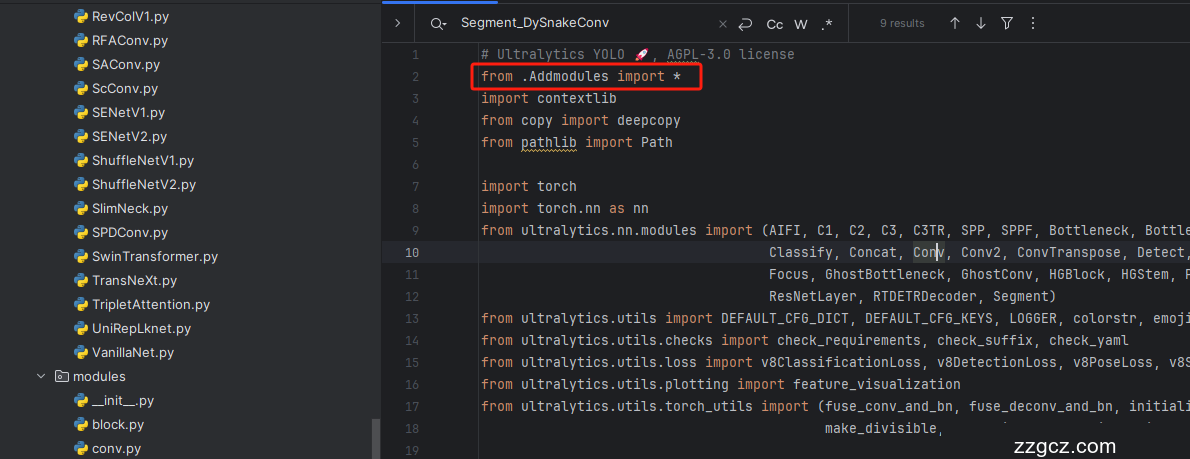
第一还是建立文件,我们找到如下 ultralytics /nn文件夹下建立一个目录名字呢就是'Addmodules'文件夹( 用群内的文件的话已经有了无需新建) !然后在其内部建立一个新的py文件将核心代码复制粘贴进去即可。

4.1.2 修改二
第二步我们在该目录下创建一个新的py文件名字为'__init__.py'( 用群内的文件的话已经有了无需新建) ,然后在其内部导入我们的检测头如下图所示。

4.1.3 修改三
第三步我门中到如下文件'ultralytics/nn/tasks.py'进行导入和注册我们的模块( 用群内的文件的话已经有了无需重新导入直接开始第四步即可) !
从今天开始以后的教程就都统一成这个样子了,因为我默认大家用了我群内的文件来进行修改!!
4.1.4 修改四
按照我的添加在parse_model里添加即可。

到此就修改完成了,大家可以复制下面的yaml文件运行。
4.2 Diverse Branch Block的yaml文件和训练截图
下面推荐几个版本的yaml文件给大家,大家可以复制进行训练,但是组合用很多具体那种最有效果都不一定,针对不同的数据集效果也不一样,我不可每一种都做实验,所以我下面推荐了三种我自己认为可能有效果的配合方式,你也可以自己进行组合。
4.2.1 Diverse Branch Block的yaml版本一(推荐)
此版本训练信息:YOLO11-C3k2-DBB-backbone summary: 496 layers, 2,877,423 parameters, 2,877,407 gradients, 7.1 GFLOPs
- # Ultralytics YOLO 🚀, AGPL-3.0 license
- # YOLO11 object detection model with P3-P5 outputs. For Usage examples see https://docs.ultralytics.com/tasks/detect
- # Parameters
- nc: 80 # number of classes
- scales: # model compound scaling constants, i.e. 'model=yolo11n.yaml' will call yolo11.yaml with scale 'n'
- # [depth, width, max_channels]
- n: [0.50, 0.25, 1024] # summary: 319 layers, 2624080 parameters, 2624064 gradients, 6.6 GFLOPs
- s: [0.50, 0.50, 1024] # summary: 319 layers, 9458752 parameters, 9458736 gradients, 21.7 GFLOPs
- m: [0.50, 1.00, 512] # summary: 409 layers, 20114688 parameters, 20114672 gradients, 68.5 GFLOPs
- l: [1.00, 1.00, 512] # summary: 631 layers, 25372160 parameters, 25372144 gradients, 87.6 GFLOPs
- x: [1.00, 1.50, 512] # summary: 631 layers, 56966176 parameters, 56966160 gradients, 196.0 GFLOPs
- # YOLO11n backbone
- backbone:
- # [from, repeats, module, args]
- - [-1, 1, Conv, [64, 3, 2]] # 0-P1/2
- - [-1, 1, Conv, [128, 3, 2]] # 1-P2/4
- - [-1, 2, C3k2_DBB_backbone, [256, False, 0.25]]
- - [-1, 1, Conv, [256, 3, 2]] # 3-P3/8
- - [-1, 2, C3k2_DBB_backbone, [512, False, 0.25]]
- - [-1, 1, Conv, [512, 3, 2]] # 5-P4/16
- - [-1, 2, C3k2_DBB_backbone, [512, True]]
- - [-1, 1, Conv, [1024, 3, 2]] # 7-P5/32
- - [-1, 2, C3k2_DBB_backbone, [1024, True]]
- - [-1, 1, SPPF, [1024, 5]] # 9
- - [-1, 2, C2PSA, [1024]] # 10
- # YOLO11n head
- head:
- - [-1, 1, nn.Upsample, [None, 2, "nearest"]]
- - [[-1, 6], 1, Concat, [1]] # cat backbone P4
- - [-1, 2, C3k2_DBB_backbone, [512, False]] # 13
- - [-1, 1, nn.Upsample, [None, 2, "nearest"]]
- - [[-1, 4], 1, Concat, [1]] # cat backbone P3
- - [-1, 2, C3k2_DBB_backbone, [256, False]] # 16 (P3/8-small)
- - [-1, 1, Conv, [256, 3, 2]]
- - [[-1, 13], 1, Concat, [1]] # cat head P4
- - [-1, 2, C3k2_DBB_backbone, [512, False]] # 19 (P4/16-medium)
- - [-1, 1, Conv, [512, 3, 2]]
- - [[-1, 10], 1, Concat, [1]] # cat head P5
- - [-1, 2, C3k2_DBB_backbone, [1024, True]] # 22 (P5/32-large)
- - [[16, 19, 22], 1, Detect, [nc]] # Detect(P3, P4, P5)
4.2.2 Diverse Branch Block的yaml版本二
添加的版本二具体那种适合你需要大家自己多做实验来尝试。
此版本训练信息:YOLO11-C3k2-DBB-neck summary: 416 layers, 2,815,199 parameters, 2,815,183 gradients, 6.7 GFLOPs
- # Ultralytics YOLO 🚀, AGPL-3.0 license
- # YOLO11 object detection model with P3-P5 outputs. For Usage examples see https://docs.ultralytics.com/tasks/detect
- # Parameters
- nc: 80 # number of classes
- scales: # model compound scaling constants, i.e. 'model=yolo11n.yaml' will call yolo11.yaml with scale 'n'
- # [depth, width, max_channels]
- n: [0.50, 0.25, 1024] # summary: 319 layers, 2624080 parameters, 2624064 gradients, 6.6 GFLOPs
- s: [0.50, 0.50, 1024] # summary: 319 layers, 9458752 parameters, 9458736 gradients, 21.7 GFLOPs
- m: [0.50, 1.00, 512] # summary: 409 layers, 20114688 parameters, 20114672 gradients, 68.5 GFLOPs
- l: [1.00, 1.00, 512] # summary: 631 layers, 25372160 parameters, 25372144 gradients, 87.6 GFLOPs
- x: [1.00, 1.50, 512] # summary: 631 layers, 56966176 parameters, 56966160 gradients, 196.0 GFLOPs
- # YOLO11n backbone
- backbone:
- # [from, repeats, module, args]
- - [-1, 1, Conv, [64, 3, 2]] # 0-P1/2
- - [-1, 1, Conv, [128, 3, 2]] # 1-P2/4
- - [-1, 2, C3k2_DBB_neck, [256, False, 0.25]]
- - [-1, 1, Conv, [256, 3, 2]] # 3-P3/8
- - [-1, 2, C3k2_DBB_neck, [512, False, 0.25]]
- - [-1, 1, Conv, [512, 3, 2]] # 5-P4/16
- - [-1, 2, C3k2_DBB_neck, [512, True]]
- - [-1, 1, Conv, [1024, 3, 2]] # 7-P5/32
- - [-1, 2, C3k2_DBB_neck, [1024, True]]
- - [-1, 1, SPPF, [1024, 5]] # 9
- - [-1, 2, C2PSA, [1024]] # 10
- # YOLO11n head
- head:
- - [-1, 1, nn.Upsample, [None, 2, "nearest"]]
- - [[-1, 6], 1, Concat, [1]] # cat backbone P4
- - [-1, 2, C3k2_DBB_neck, [512, False]] # 13
- - [-1, 1, nn.Upsample, [None, 2, "nearest"]]
- - [[-1, 4], 1, Concat, [1]] # cat backbone P3
- - [-1, 2, C3k2_DBB_neck, [256, False]] # 16 (P3/8-small)
- - [-1, 1, Conv, [256, 3, 2]]
- - [[-1, 13], 1, Concat, [1]] # cat head P4
- - [-1, 2, C3k2_DBB_neck, [512, False]] # 19 (P4/16-medium)
- - [-1, 1, Conv, [512, 3, 2]]
- - [[-1, 10], 1, Concat, [1]] # cat head P5
- - [-1, 2, C3k2_DBB_neck, [1024, True]] # 22 (P5/32-large)
- - [[16, 19, 22], 1, Detect, [nc]] # Detect(P3, P4, P5)
4.2.3Diverse Branch Block的yaml版本三
此版本训练信息:YOLO11-DBB summary: 416 layers, 3,471,487 parameters, 3,471,471 gradients, 9.2 GFLOPs
- # Ultralytics YOLO 🚀, AGPL-3.0 license
- # YOLO11 object detection model with P3-P5 outputs. For Usage examples see https://docs.ultralytics.com/tasks/detect
- # Parameters
- nc: 80 # number of classes
- scales: # model compound scaling constants, i.e. 'model=yolo11n.yaml' will call yolo11.yaml with scale 'n'
- # [depth, width, max_channels]
- n: [0.50, 0.25, 1024] # summary: 319 layers, 2624080 parameters, 2624064 gradients, 6.6 GFLOPs
- s: [0.50, 0.50, 1024] # summary: 319 layers, 9458752 parameters, 9458736 gradients, 21.7 GFLOPs
- m: [0.50, 1.00, 512] # summary: 409 layers, 20114688 parameters, 20114672 gradients, 68.5 GFLOPs
- l: [1.00, 1.00, 512] # summary: 631 layers, 25372160 parameters, 25372144 gradients, 87.6 GFLOPs
- x: [1.00, 1.50, 512] # summary: 631 layers, 56966176 parameters, 56966160 gradients, 196.0 GFLOPs
- # YOLO11n backbone
- backbone:
- # [from, repeats, module, args]
- - [-1, 1, Conv, [64, 3, 2]] # 0-P1/2
- - [-1, 1, DiverseBranchBlock, [128, 3, 2]] # 1-P2/4
- - [-1, 2, C3k2, [256, False, 0.25]]
- - [-1, 1, DiverseBranchBlock, [256, 3, 2]] # 3-P3/8
- - [-1, 2, C3k2, [512, False, 0.25]]
- - [-1, 1, DiverseBranchBlock, [512, 3, 2]] # 5-P4/16
- - [-1, 2, C3k2, [512, True]]
- - [-1, 1, DiverseBranchBlock, [1024, 3, 2]] # 7-P5/32
- - [-1, 2, C3k2, [1024, True]]
- - [-1, 1, SPPF, [1024, 5]] # 9
- - [-1, 2, C2PSA, [1024]] # 10
- # YOLO11n head
- head:
- - [-1, 1, nn.Upsample, [None, 2, "nearest"]]
- - [[-1, 6], 1, Concat, [1]] # cat backbone P4
- - [-1, 2, C3k2, [512, False]] # 13
- - [-1, 1, nn.Upsample, [None, 2, "nearest"]]
- - [[-1, 4], 1, Concat, [1]] # cat backbone P3
- - [-1, 2, C3k2, [256, False]] # 16 (P3/8-small)
- - [-1, 1, DiverseBranchBlock, [256, 3, 2]]
- - [[-1, 13], 1, Concat, [1]] # cat head P4
- - [-1, 2, C3k2, [512, False]] # 19 (P4/16-medium)
- - [-1, 1, DiverseBranchBlock, [512, 3, 2]]
- - [[-1, 10], 1, Concat, [1]] # cat head P5
- - [-1, 2, C3k2, [1024, True]] # 22 (P5/32-large)
- - [[16, 19, 22], 1, Detect, [nc]] # Detect(P3, P4, P5)
4.2.2 Diverse Branch Block的训练过程截图
下面是添加了 Diverse Branch Block 的训练截图。

五、本文总结
到此本文的正式分享内容就结束了,在这里给大家推荐我的YOLOv11改进有效涨点专栏,本专栏目前为新开的平均质量分98分,后期我会根据各种最新的前沿顶会进行论文复现,也会对一些老的改进机制进行补充,如果大家觉得本文帮助到你了,订阅本专栏,关注后续更多的更新~
