💡💡💡创新点:来自 MIT 等机构的研究者提出了一种非常有潜力的替代方法 KAN。该方法在准确性和可解释性方面表现优于 MLP。而且,它能以非常少的参数量胜过以更大参数量运行的 MLP。
KAN 在边上具有激活函数,而 MLP 在节点上具有激活函数。KAN 似乎比 MLP 的参数效率更高
💡💡💡如何跟YOLOv8结合:KANConv结合C2f从而替代YOLOv8的C2f,结构图如下
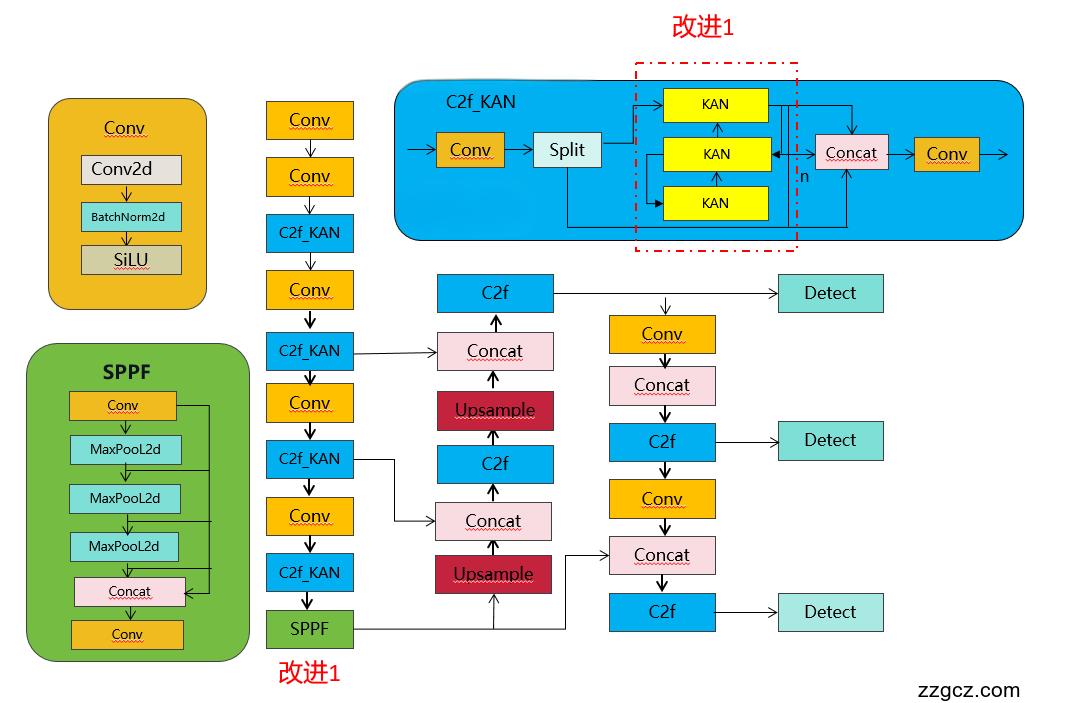
YOLOv8原创自研
💡💡💡全网独家首发创新(原创),适合paper !!!
💡💡💡 2024年计算机视觉顶会创新点适用于Yolov5、Yolov7、Yolov8等各个Yolo系列,专栏文章提供每一步步骤和源码,轻松带你上手魔改网络 !!!
💡💡💡重点:通过本专栏的阅读,后续你也可以设计魔改网络,在网络不同位置(Backbone、head、detect、loss等)进行魔改,实现创新!!!
1.原理介绍

摘要:受Kolmogorov-Arnold表示定理的启发,我们提出Kolmogorov-Arnold网络(KANs)作为多层感知器(mlp)的有前途的替代品。mlp在节点(“神经元”)上有固定的激活函数,而kan在边缘(“权重”)上有可学习的激活函数。kan根本没有线性权重——每个权重参数都被参数化为样条的单变量函数所取代。我们表明,这个看似简单的改变使得KANs在准确性和可解释性方面优于mlp。就准确性而言,在数据拟合和PDE求解方面,更小的kan可以达到与更大的mlp相当或更好的准确性。从理论上和实证上看,kan比mlp具有更快的神经尺度规律。对于可解释性,KANs可以直观地可视化,并且可以轻松地与人类用户交互。通过数学和物理的两个例子,kan被证明是有用的“合作者”,帮助科学家(重新)发现数学和物理定律。总之,KANs是mlp的有希望的替代品,为进一步改进当今严重依赖mlp的深度学习模型提供了机会。
KAN 在边上具有激活函数,而 MLP 在节点上具有激活函数。KAN 看起来比 MLP 的参数效率更高,但每个 KAN 层比 MLP 层拥有更多的参数。

我们提出的Kolmogorov-Arnold网络是为了纪念两位伟大的已故数学家,Andrey
Kolmogorov和Vladimir Arnold。kan在数学上是合理的、准确的和可解释的。
 2.如何将入到YOLOv8
2.1 新建ultralytics/nn/conv/kan_conv.py
import torch
import torch.nn as nn

from ultralytics.nn.modules import (Conv,C3, Bottleneck,C2f)
class KANConvNDLayer(nn.Module):
    def __init__(self, conv_class, norm_class, input_dim, output_dim, spline_order, kernel_size,
                 groups=1, padding=0, stride=1, dilation=1,
                 ndim: int = 2, grid_size=5, base_activation=nn.GELU, grid_range=[-1, 1], dropout=0.0):
        super(KANConvNDLayer, self).__init__()
        self.inputdim = input_dim
        self.outdim = output_dim
        self.spline_order = spline_order
        self.kernel_size = kernel_size
        self.padding = padding
        self.stride = stride
        self.dilation = dilation
        self.groups = groups
        self.ndim = ndim
        self.grid_size = grid_size
        self.base_activation = base_activation()
        self.grid_range = grid_range

        self.dropout = None
        if dropout > 0:
            if ndim == 1:
                self.dropout = nn.Dropout1d(p=dropout)
            if ndim == 2:
                self.dropout = nn.Dropout2d(p=dropout)
            if ndim == 3:
                self.dropout = nn.Dropout3d(p=dropout)
        if groups <= 0:
            raise ValueError('groups must be a positive integer')
        if input_dim % groups != 0:
            raise ValueError('input_dim must be divisible by groups')
        if output_dim % groups != 0:
            raise ValueError('output_dim must be divisible by groups')

        self.base_conv = nn.ModuleList([conv_class(input_dim // groups,
                                                   output_dim // groups,
                                                   kernel_size,
                                                   stride,
                                                   padding,
                                                   dilation,
                                                   groups=1,
                                                   bias=False) for _ in range(groups)])

        self.spline_conv = nn.ModuleList([conv_class((grid_size + spline_order) * input_dim // groups,
                                                     output_dim // groups,
                                                     kernel_size,
                                                     stride,
                                                     padding,
                                                     dilation,
                                                     groups=1,
                                                     bias=False) for _ in range(groups)])

        self.layer_norm = nn.ModuleList([norm_class(output_dim // groups) for _ in range(groups)])

        self.prelus = nn.ModuleList([nn.PReLU() for _ in range(groups)])

        h = (self.grid_range[1] - self.grid_range[0]) / grid_size
        self.grid = torch.linspace(
            self.grid_range[0] - h * spline_order,
            self.grid_range[1] + h * spline_order,
            grid_size + 2 * spline_order + 1,
            dtype=torch.float32
        )
        # Initialize weights using Kaiming uniform distribution for better training start
        for conv_layer in self.base_conv:
            nn.init.kaiming_uniform_(conv_layer.weight, nonlinearity='linear')

        for conv_layer in self.spline_conv:
            nn.init.kaiming_uniform_(conv_layer.weight, nonlinearity='linear')

    def forward_kan(self, x, group_index):

        # Apply base activation to input and then linear transform with base weights
        base_output = self.base_conv[group_index](self.base_activation(x))

        x_uns = x.unsqueeze(-1)  # Expand dimensions for spline operations.
        # Compute the basis for the spline using intervals and input values.
        target = x.shape[1:] + self.grid.shape
        grid = self.grid.view(*list([1 for _ in range(self.ndim + 1)] + [-1, ])).expand(target).contiguous().to(x.device)

        bases = ((x_uns >= grid[..., :-1]) & (x_uns < grid[..., 1:])).to(x.dtype)

        # Compute the spline basis over multiple orders.
        for k in range(1, self.spline_order + 1):
            left_intervals = grid[..., :-(k + 1)]
            right_intervals = grid[..., k:-1]
            delta = torch.where(right_intervals == left_intervals, torch.ones_like(right_intervals),
                                right_intervals - left_intervals)
            bases = ((x_uns - left_intervals) / delta * bases[..., :-1]) + \
                    ((grid[..., k + 1:] - x_uns) / (grid[..., k + 1:] - grid[..., 1:(-k)]) * bases[..., 1:])
        bases = bases.contiguous()
        bases = bases.moveaxis(-1, 2).flatten(1, 2)
        spline_output = self.spline_conv[group_index](bases)
        x = self.prelus[group_index](self.layer_norm[group_index](base_output + spline_output))

        if self.dropout is not None:
            x = self.dropout(x)

        return x

    def forward(self, x):
        split_x = torch.split(x, self.inputdim // self.groups, dim=1)
        output = []
        for group_ind, _x in enumerate(split_x):
            y = self.forward_kan(_x, group_ind)
            output.append(y.clone())
        y = torch.cat(output, dim=1)
        return y

class KANConv2DLayer(KANConvNDLayer):
    def __init__(self, input_dim, output_dim, kernel_size, spline_order=3, groups=1, padding=0, stride=1, dilation=1,
                 grid_size=5, base_activation=nn.GELU, grid_range=[-1, 1], dropout=0.0):
        super(KANConv2DLayer, self).__init__(nn.Conv2d, nn.InstanceNorm2d,
                                             input_dim, output_dim,
                                             spline_order, kernel_size,
                                             groups=groups, padding=padding, stride=stride, dilation=dilation,
                                             ndim=2,
                                             grid_size=grid_size, base_activation=base_activation,
                                             grid_range=grid_range, dropout=dropout)

class Bottleneck_KAN(Bottleneck):
    def __init__(self, c1, c2, kan_mothed, shortcut=True, g=1, k=(3, 3), e=0.5):
        super().__init__(c1, c2, shortcut, g, k, e)
        c_ = int(c2 * e)  # hidden channels
        self.cv1 = KANConv2DLayer(c1, c_, k[0], padding=k[0] // 2)
        self.cv2 = KANConv2DLayer(c_, c2, k[1], padding=k[1] // 2)

class C2f_KAN(C2f):
    def __init__(self, c1, c2, n=1, shortcut=False, g=1, e=0.5):
        super().__init__(c1, c2, n, shortcut, g, e)
        self.m = nn.ModuleList(Bottleneck_KAN(self.c, self.c, shortcut, g, k=(3, 3), e=1.0) for _ in range(n))
2.2 修改task.py
1)首先进行注册
from ultralytics.nn.conv.kan_conv import C2f_KAN2)修改def parse_model(d, ch, verbose=True): # model_dict, input_channels(3)
不要直接复制以下代码,只需要将 C2f_KAN加入你的工程
        n = n_ = max(round(n * depth), 1) if n > 1 else n  # depth gain
        if m in (
            Classify,
            Conv,
            ConvTranspose,
            GhostConv,
            Bottleneck,
            GhostBottleneck,
            SPP,
            SPPF,
            DWConv,
            Focus,
            BottleneckCSP,
            C1,
            C2,
            C2f,
            C2fAttn,
            C3,
            C3TR,
            C3Ghost,
            nn.ConvTranspose2d,
            DWConvTranspose2d,
            C3x,
            RepC3,
            C2f_KAN
        ):
            c1, c2 = ch[f], args[0]
            if c2 != nc:  # if c2 not equal to number of classes (i.e. for Classify() output)
                c2 = make_divisible(min(c2, max_channels) * width, 8)

            args = [c1, c2, *args[1:]]

            if m in (BottleneckCSP, C1, C2, C2f, C2fAttn, C3, C3TR, C3Ghost, C3x, RepC3,C2f_KAN):
                args.insert(2, n)  # number of repeats
n = 1 
2.3 yolov8_C2f_KAN.yaml
# Ultralytics YOLO 🚀, AGPL-3.0 license
# YOLOv8 object detection model with P3-P5 outputs. For Usage examples see https://docs.ultralytics.com/tasks/detect

# Parameters
nc: 80 # number of classes
scales: # model compound scaling constants, i.e. 'model=yolov8n.yaml' will call yolov8.yaml with scale 'n'
  # [depth, width, max_channels]
  n: [0.33, 0.25, 1024] # YOLOv8n summary: 225 layers,  3157200 parameters,  3157184 gradients,   8.9 GFLOPs
  s: [0.33, 0.50, 1024] # YOLOv8s summary: 225 layers, 11166560 parameters, 11166544 gradients,  28.8 GFLOPs
  m: [0.67, 0.75, 768] # YOLOv8m summary: 295 layers, 25902640 parameters, 25902624 gradients,  79.3 GFLOPs
  l: [1.00, 1.00, 512] # YOLOv8l summary: 365 layers, 43691520 parameters, 43691504 gradients, 165.7 GFLOPs
  x: [1.00, 1.25, 512] # YOLOv8x summary: 365 layers, 68229648 parameters, 68229632 gradients, 258.5 GFLOPs

# YOLOv8.0n backbone
backbone:
  # [from, repeats, module, args]
  - [-1, 1, Conv, [64, 3, 2]] # 0-P1/2
  - [-1, 1, Conv, [128, 3, 2]] # 1-P2/4
  - [-1, 3, C2f_KAN, [128, True]]
  - [-1, 1, Conv, [256, 3, 2]] # 3-P3/8
  - [-1, 6, C2f_KAN, [256, True]]
  - [-1, 1, Conv, [512, 3, 2]] # 5-P4/16
  - [-1, 6, C2f_KAN, [512, True]]
  - [-1, 1, Conv, [1024, 3, 2]] # 7-P5/32
  - [-1, 3, C2f_KAN, [1024, True]]
  - [-1, 1, SPPF, [1024, 5]] # 9

# YOLOv8.0n head
head:
  - [-1, 1, nn.Upsample, [None, 2, "nearest"]]
  - [[-1, 6], 1, Concat, [1]] # cat backbone P4
  - [-1, 3, C2f, [512]] # 12

  - [-1, 1, nn.Upsample, [None, 2, "nearest"]]
  - [[-1, 4], 1, Concat, [1]] # cat backbone P3
  - [-1, 3, C2f, [256]] # 15 (P3/8-small)

  - [-1, 1, Conv, [256, 3, 2]]
  - [[-1, 12], 1, Concat, [1]] # cat head P4
  - [-1, 3, C2f, [512]] # 18 (P4/16-medium)

  - [-1, 1, Conv, [512, 3, 2]]
  - [[-1, 9], 1, Concat, [1]] # cat head P5
  - [-1, 3, C2f, [1024]] # 21 (P5/32-large)

  - [[15, 18, 21], 1, Detect, [nc]] # Detect(P3, P4, P5)