💡💡💡本文原创自研创新改进:提出了一种新的基于尺度变化的注意力网络,用于小尺度目标检测分割。蒙特卡罗注意力(MCAttn)模块使用基于随机抽样的池化操作来生成与尺度无关的注意力图。这使得网络能够捕获不同尺度的相关信息,增强其识别小目标识别分割能力。
💡💡💡新颖度足够,全网独家首发推荐指数五颗星,适用于小目标检测,高效涨点

改进1结构图:
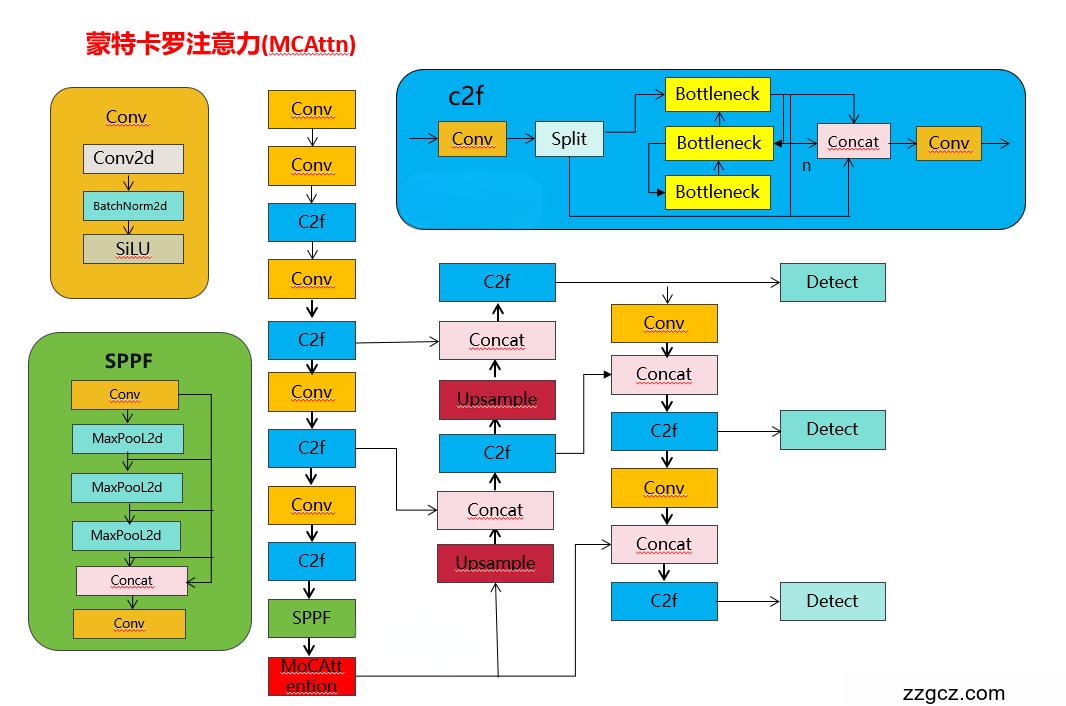
YOLOv8原创自研
💡💡💡全网独家首发创新(原创),适合paper !!!
💡💡💡 2024年计算机视觉顶会创新点适用于Yolov5、Yolov7、Yolov8等各个Yolo系列,专栏文章提供每一步步骤和源码,轻松带你上手魔改网络 !!!
💡💡💡重点:通过本专栏的阅读,后续你也可以设计魔改网络,在网络不同位置(Backbone、head、detect、loss等)进行魔改,实现创新!!!
1.原理介绍

摘要:早期发现和准确诊断可以预测恶性疾病转化的风险,从而增加有效治疗的概率。轻度综合症
小的感染区域是一个不祥的警告,在疾病的早期诊断中是最重要的。卷积神经网络(cnn)等深度学习算法已被用于分割自然物体或医疗物体,并显示出良好的效果。然而,由于cnn的卷积和池化操作导致的信息丢失和压缩缺陷,对图像中小区域的医学对象进行分析仍然是一个挑战。随着网络的深入,这些损失和缺陷变得越来越明显,特别是对于小型医疗对象。为了解决这些挑战,我们提出了一种新的基于尺度变化的注意力网络(SvANet),用于医学图像中精确的小尺度目标分割。SvANet由蒙特卡罗注意、尺度变化注意和视觉变换组成,融合了跨尺度特征,减轻了压缩伪影,增强了对小型医疗物体的识别。定量实验结果表明,SvANet在分割肾肿瘤、皮肤病变、肝脏肿瘤、息肉、手术切除细胞、视网膜血管和精子方面的平均Dice系数分别达到96.12%、96.11%、89.79%、84.15%、80.25%、73.05%和72.58%,在KiTS23、ISIC 2018、ATLAS、polygen、TissueNet、FIVES和SpermHealth数据集中,这些数据分别占不到1%的图像区域。

图1:scale-variant attention-based network (SvANet)的架构。蒙特卡罗注意力(MCAttn)和基于MCAttn的瓶颈(mc瓶颈)模块,位于左上角的虚线框中,分别学习全局和局部特征。跨尺度引导和尺度变化注意(SvAttn)技术,如图中上虚线框所示,集成了低级和高级特征映射。通过装配张量(AssemFormer)(位于右上方虚线框中)与视觉变压器进行卷积,将局部和全局特征协同关联,结合了卷积神经网络和视觉变压器的优势。
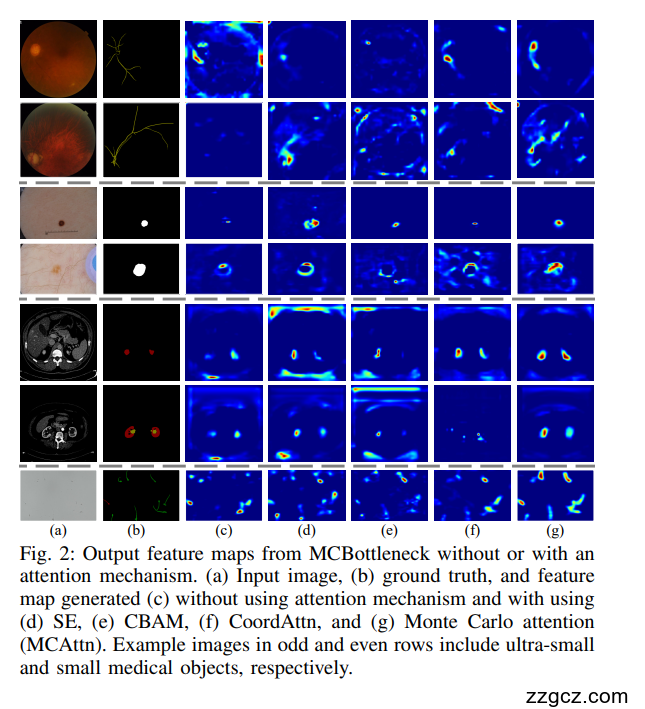
受这种现象的启发,蒙特卡罗注意力(MCAttn)模块使用基于随机抽样的池化操作来生成与尺度无关的注意力图。这使得网络能够捕获不同尺度的相关信息,增强其识别小型医疗对象的能力
在图1中,紫色块表示的MCAttn通过从三个尺度:3×3, 2×2和1×1(池张量)中随机选择1×1注意图来生成注意图。
2.如何加入YOLOv8
3.1新建加入ultralytics/nn/attention/mcattn.py
import numpy as np
from typing import Any, Callable

import torch
from torch import nn, Tensor
from typing import List, Optional
import math

from ultralytics.nn.modules.conv import Conv

def makeDivisible(v: float, divisor: int, min_value: Optional[int] = None) -> int:
    """
    This function is taken from the original tf repo.
    It ensures that all layers have a channel number that is divisible by 8
    It can be seen here:
    https://github.com/tensorflow/models/blob/master/research/slim/nets/mobilenet/mobilenet.Py
    """
    if min_value is None:
        min_value = divisor
    new_v = max(min_value, int(v + divisor / 2) // divisor * divisor)
    # Make sure that round down does not go down by more than 10%.
    if new_v < 0.9 * v:
        new_v += divisor
    return new_v

def callMethod(self, ElementName):
    return getattr(self, ElementName)

def setMethod(self, ElementName, ElementValue):
    return setattr(self, ElementName, ElementValue)
def shuffleTensor(Feature: Tensor, Mode: int=1) -> Tensor:
    # shuffle multiple tensors with the same indexs
    # all tensors must have the same shape
    if isinstance(Feature, Tensor):
        Feature = [Feature]

    Indexs = None
    Output = []
    for f in Feature:
        # not in-place operation, should update output
        B, C, H, W = f.shape
        if Mode == 1:
            # fully shuffle
            f = f.flatten(2)
            if Indexs is None:
                Indexs = torch.randperm(f.shape[-1], device=f.device)
            f = f[:, :, Indexs.to(f.device)]
            f = f.reshape(B, C, H, W)
        else:
            # shuflle along y and then x axis
            if Indexs is None:
                Indexs = [torch.randperm(H, device=f.device),
                          torch.randperm(W, device=f.device)]
            f = f[:, :, Indexs[0].to(f.device)]
            f = f[:, :, :, Indexs[1].to(f.device)]
        Output.append(f)
    return Output

class AdaptiveAvgPool2d(nn.AdaptiveAvgPool2d):
    def __init__(self, output_size: int or tuple=1):
        super(AdaptiveAvgPool2d, self).__init__(output_size=output_size)

    def profileModule(self, Input: Tensor):
        Output = self.forward(Input)
        return Output, 0.0, 0.0

class AdaptiveMaxPool2d(nn.AdaptiveMaxPool2d):
    def __init__(self, output_size: int or tuple=1):
        super(AdaptiveMaxPool2d, self).__init__(output_size=output_size)

    def profileModule(self, Input: Tensor):
        Output = self.forward(Input)
        return Output, 0.0, 0.0

NormLayerTuple = (
    nn.BatchNorm1d,
    nn.BatchNorm2d,
    nn.SyncBatchNorm,
    nn.LayerNorm,
    nn.InstanceNorm1d,
    nn.InstanceNorm2d,
    nn.GroupNorm,
    nn.BatchNorm3d,
)

def initWeight(Module):
    # init conv, norm , and linear layers
    ## empty module
    if Module is None:
        return
    ## conv layer
    elif isinstance(Module, (nn.Conv2d, nn.Conv3d, nn.ConvTranspose2d)):
        nn.init.kaiming_uniform_(Module.weight, a=math.sqrt(5))
        if Module.bias is not None:
            fan_in, _ = nn.init._calculate_fan_in_and_fan_out(Module.weight)
            if fan_in != 0:
                bound = 1 / math.sqrt(fan_in)
                nn.init.uniform_(Module.bias, -bound, bound)
    ## norm layer
    elif isinstance(Module, NormLayerTuple):
        if Module.weight is not None:
            nn.init.ones_(Module.weight)
        if Module.bias is not None:
            nn.init.zeros_(Module.bias)
    ## linear layer
    elif isinstance(Module, nn.Linear):
        nn.init.kaiming_uniform_(Module.weight, a=math.sqrt(5))
        if Module.bias is not None:
            fan_in, _ = nn.init._calculate_fan_in_and_fan_out(Module.weight)
            bound = 1 / math.sqrt(fan_in) if fan_in > 0 else 0
            nn.init.uniform_(Module.bias, -bound, bound)
    elif isinstance(Module, (nn.Sequential, nn.ModuleList)):
        for m in Module:
            initWeight(m)
    elif list(Module.children()):
        for m in Module.children():
            initWeight(m)

class BaseConv2d(nn.Module):
    def __init__(
            self,
            in_channels: int,
            out_channels: int,
            kernel_size: int,
            stride: Optional[int] = 1,
            padding: Optional[int] = None,
            groups: Optional[int] = 1,
            bias: Optional[bool] = None,
            BNorm: bool = False,
            # norm_layer: Optional[Callable[..., nn.Module]]=nn.BatchNorm2d,
            ActLayer: Optional[Callable[..., nn.Module]] = None,
            dilation: int = 1,
            Momentum: Optional[float] = 0.1,
            **kwargs: Any
    ) -> None:
        super(BaseConv2d, self).__init__()
        if padding is None:
            padding = int((kernel_size - 1) // 2 * dilation)

        if bias is None:
            bias = not BNorm

        self.in_channels = in_channels
        self.out_channels = out_channels
        self.kernel_size = kernel_size
        self.stride = stride
        self.padding = padding
        self.groups = groups
        self.bias = bias

        self.Conv = nn.Conv2d(in_channels, out_channels,
                              kernel_size, stride, padding, dilation, groups, bias, **kwargs)

        self.Bn = nn.BatchNorm2d(out_channels, eps=0.001, momentum=Momentum) if BNorm else nn.Identity()

        if ActLayer is not None:
            if isinstance(list(ActLayer().named_modules())[0][1], nn.Sigmoid):
                self.Act = ActLayer()
            else:
                self.Act = ActLayer(inplace=True)
        else:
            self.Act = ActLayer

        self.apply(initWeight)

    def forward(self, x: Tensor) -> Tensor:
        x = self.Conv(x)
        x = self.Bn(x)
        if self.Act is not None:
            x = self.Act(x)
        return x

    def profileModule(self, Input: Tensor):
        if Input.dim() != 4:
            print('Conv2d requires 4-dimensional Input (BxCxHxW). Provided Input has shape: {}'.format(Input.size()))

        BatchSize, in_channels, in_h, in_w = Input.size()
        assert in_channels == self.in_channels, '{}!={}'.format(in_channels, self.in_channels)

        k_h, k_w = pair(self.kernel_size)
        stride_h, stride_w = pair(self.stride)
        pad_h, pad_w = pair(self.padding)
        groups = self.groups

        out_h = (in_h - k_h + 2 * pad_h) // stride_h + 1
        out_w = (in_w - k_w + 2 * pad_w) // stride_w + 1

        # compute MACs
        MACs = (k_h * k_w) * (in_channels * self.out_channels) * (out_h * out_w) * 1.0
        MACs /= groups

        if self.bias:
            MACs += self.out_channels * out_h * out_w

        # compute parameters
        Params = sum([p.numel() for p in self.parameters()])

        Output = torch.zeros(size=(BatchSize, self.out_channels, out_h, out_w), dtype=Input.dtype, device=Input.device)
        # print(MACs)
        return Output, Params, MACs

class MoCAttention(nn.Module):
    # Monte carlo attention
    def __init__(
        self,
        InChannels: int,
        HidChannels: int=None,
        SqueezeFactor: int=4,
        PoolRes: list=[1, 2, 3],
        Act: Callable[..., nn.Module]=nn.ReLU,
        ScaleAct: Callable[..., nn.Module]=nn.Sigmoid,
        MoCOrder: bool=True,
        **kwargs: Any,
    ) -> None:
        super().__init__()
        if HidChannels is None:
            HidChannels = max(makeDivisible(InChannels // SqueezeFactor, 8), 32)

        AllPoolRes = PoolRes + [1] if 1 not in PoolRes else PoolRes
        for k in AllPoolRes:
            Pooling = AdaptiveAvgPool2d(k)
            setMethod(self, 'Pool%d' % k, Pooling)

        self.SELayer = nn.Sequential(
            BaseConv2d(InChannels, HidChannels, 1, ActLayer=Act),
            BaseConv2d(HidChannels, InChannels, 1, ActLayer=ScaleAct),
        )

        self.PoolRes = PoolRes
        self.MoCOrder = MoCOrder

    def monteCarloSample(self, x: Tensor) -> Tensor:
        if self.training:
            PoolKeep = np.random.choice(self.PoolRes)
            x1 = shuffleTensor(x)[0] if self.MoCOrder else x
            AttnMap: Tensor = callMethod(self, 'Pool%d' % PoolKeep)(x1)
            if AttnMap.shape[-1] > 1:
                AttnMap = AttnMap.flatten(2)
                AttnMap = AttnMap[:, :, torch.randperm(AttnMap.shape[-1])[0]]
                AttnMap = AttnMap[:, :, None, None] # squeeze twice
        else:
            AttnMap: Tensor = callMethod(self, 'Pool%d' % 1)(x)

        return AttnMap

    def forward(self, x: Tensor) -> Tensor:
        AttnMap = self.monteCarloSample(x)
        return x * self.SELayer(AttnMap)

class PSMoCA(nn.Module):

    def __init__(self, c1, c2, e=0.5):
        super().__init__()
        assert (c1 == c2)
        self.c = int(c1 * e)
        self.cv1 = Conv(c1, 2 * self.c, 1, 1)
        self.cv2 = Conv(2 * self.c, c1, 1)

        self.attn = MoCAttention(self.c)
        self.ffn = nn.Sequential(
            Conv(self.c, self.c * 2, 1),
            Conv(self.c * 2, self.c, 1, act=False)
        )

    def forward(self, x):
        a, b = self.cv1(x).split((self.c, self.c), dim=1)
        b = b + self.attn(b)
        b = b + self.ffn(b)
        return self.cv2(torch.cat((a, b), 1))
3.2 注册ultralytics/nn/tasks.py
1)MoCAttention进行注册
from ultralytics.nn.attention.mcattn import MoCAttention2)修改def parse_model(d, ch, verbose=True): # model_dict, input_channels(3)
不要直接复制以下代码,只需要将 MoCAttention加入你的工程
        n = n_ = max(round(n * depth), 1) if n > 1 else n  # depth gain
        if m in (
            Classify,
            Conv,
            ConvTranspose,
            GhostConv,
            Bottleneck,
            GhostBottleneck,
            SPP,
            SPPF,
            DWConv,
            Focus,
            BottleneckCSP,
            C1,
            C2,
            C2f,
            C2fAttn,
            C3,
            C3TR,
            C3Ghost,
            nn.ConvTranspose2d,
            DWConvTranspose2d,
            C3x,
            RepC3,
            MoCAttention
        ):
            c1, c2 = ch[f], args[0]
            if c2 != nc:  # if c2 not equal to number of classes (i.e. for Classify() output)
                c2 = make_divisible(min(c2, max_channels) * width, 8)

            args = [c1, c2, *args[1:]]

            if m in (BottleneckCSP, C1, C2, C2f, C2fAttn, C3, C3TR, C3Ghost, C3x, RepC3):
                args.insert(2, n)  # number of repeats
                n = 1
2.3 yolov8-MoCAttention.yaml
# Ultralytics YOLO 🚀, AGPL-3.0 license
# YOLOv8 object detection model with P3-P5 outputs. For Usage examples see https://docs.ultralytics.com/tasks/detect

# Parameters
nc: 80 # number of classes
scales: # model compound scaling constants, i.e. 'model=yolov8n.yaml' will call yolov8.yaml with scale 'n'
  # [depth, width, max_channels]
  n: [0.33, 0.25, 1024] # YOLOv8n summary: 225 layers,  3157200 parameters,  3157184 gradients,   8.9 GFLOPs
  s: [0.33, 0.50, 1024] # YOLOv8s summary: 225 layers, 11166560 parameters, 11166544 gradients,  28.8 GFLOPs
  m: [0.67, 0.75, 768] # YOLOv8m summary: 295 layers, 25902640 parameters, 25902624 gradients,  79.3 GFLOPs
  l: [1.00, 1.00, 512] # YOLOv8l summary: 365 layers, 43691520 parameters, 43691504 gradients, 165.7 GFLOPs
  x: [1.00, 1.25, 512] # YOLOv8x summary: 365 layers, 68229648 parameters, 68229632 gradients, 258.5 GFLOPs

# YOLOv8.0n backbone
backbone:
  # [from, repeats, module, args]
  - [-1, 1, Conv, [64, 3, 2]] # 0-P1/2
  - [-1, 1, Conv, [128, 3, 2]] # 1-P2/4
  - [-1, 3, C2f, [128, True]]
  - [-1, 1, Conv, [256, 3, 2]] # 3-P3/8
  - [-1, 6, C2f, [256, True]]
  - [-1, 1, Conv, [512, 3, 2]] # 5-P4/16
  - [-1, 6, C2f, [512, True]]
  - [-1, 1, Conv, [1024, 3, 2]] # 7-P5/32
  - [-1, 3, C2f, [1024, True]]
  - [-1, 1, SPPF, [1024, 5]] # 9
  - [-1, 1, MoCAttention, [1024]] # 10

# YOLOv8.0n head
head:
  - [-1, 1, nn.Upsample, [None, 2, "nearest"]]
  - [[-1, 6], 1, Concat, [1]] # cat backbone P4
  - [-1, 3, C2f, [512]] # 13

  - [-1, 1, nn.Upsample, [None, 2, "nearest"]]
  - [[-1, 4], 1, Concat, [1]] # cat backbone P3
  - [-1, 3, C2f, [256]] # 16 (P3/8-small)

  - [-1, 1, Conv, [256, 3, 2]]
  - [[-1, 13], 1, Concat, [1]] # cat head P4
  - [-1, 3, C2f, [512]] # 19 (P4/16-medium)

  - [-1, 1, Conv, [512, 3, 2]]
  - [[-1, 10], 1, Concat, [1]] # cat head P5
  - [-1, 3, C2f, [1024]] # 22 (P5/32-large)

  - [[16, 19, 22], 1, Detect, [nc]] # Detect(P3, P4, P5)